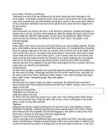
The Inuksuk Marit & Mari- Liis 9b symbol in the Arctic built from the stones "likeness of a person"( inimese sarnane) Used in many different ways. the way home warn of dangerous places showed where food was stored help hunt caribou herds (karjad) work of humans many Inuit lived on the sea ice stars in the night sky were important. Some Inuksuit were built to point toward the North Star Today much more than just a stone marker( kivid) symbol of the North and of leadership Traditional to mark their presence both in the Arctic and across this country. http://www.flickr.com/photos/aqaf33/6092241093/ http://www.pic2fly.com/Inutchuk.html http://www
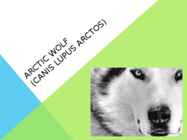
S) T O RC LF A O US W P I C LU C T S R I A AN (C ARCTIC WOLF, POLAR WOLF, WHITE WOLF • Weight: 45-70kg • They are not fast runners. • They hunt in packs. • They prey mainly on caribou and muskoxen, but also arctic hares, seals, ptarmigan, lemmings and smaller animals such as waterfowl. ARCTIC WOLVES ARE SMALLER THAN GREY WOLVES, THEY ALSO HAVE SMALLER EARS AND SHORTER MUZZLES TO RETAIN BODY HEAT. GREY WOLF ARCTIC WOLF HABITAT AND DISTRIBUTION • They have lived in North America for more than two million years. • The arctic wolf inhabits the Canadian Arctic and the islands,
7 million) Northern Canada: mainly forest, tundra, ice and snow Western Canada: Rocky Mountains Highest mountain: Mount Logan (5 951 m) West-central Canada: prairie grassland Most important river: St Lawrence Longest river: Mackenzie (4,241 km) Niagara Falls: largest falls in the world Also 2 million lakes, over 60% of the world's lakes Industry: mining, oil and gas, paper, motor vehicles, fishing Agriculture: wheat, fruit and vegetables Canadian wildlife: polar bear, moose, caribou, elk, brown bear, grizzly bear, several kinds of wild cat, whales off east/west coasts Over 500 different kinds of birds Central Canada: short hot summers, long cold winters East and west coasts: warmer winters, cooler summers Ottawa average temperatures: minus 15° to minus 6°C in January; 15° to 26°C in July Northern Canada: extremely cold all year West and south-east Canada: a lot of rain; other areas much drier
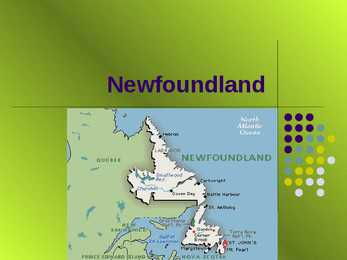
orchids and plants, in bogs and marshland. Landscape holds, the most delightful just might be sweet, fresh berries(blueberries, partridgeberries, blackberries or crowberries) Bakeapples, also called cloudberries, are a local favourite. Wildlife There's no shortage of wildlife in Newfoundland and Labrador . There are more than 120,000 moose and the population density in Gros Morne National Park is one of the highest in North America . It's also home to one of the world's largest caribou herds and some of the continent's biggest black bears. People Newfoundland and Labrador is known for its friendly people. Real and genuine, warm and welcoming.
Triin Õismaa Brown bear. Most widely distributed. Cubs birth. Extremely fast. Range in colours. Cubs can climb. Male bear's heavier. Poor eyesight. Black bear. Seen in different shades. Shy, easy to frighten, curious. Good climbers and swimmers. Live over 25 years. Good hearing, sense of smell. Polar bear. Only humans prey or hunt. Fur is not white. Tend to overheat more. Can swim up to 100 miles (161 km). Cubs learn to freeze. Caribou. Covered with winter coat. Wear antlers. Releases special scent when faced with danger. Live about 4,5 years. Very fast. Moose. Largest members of the deer family. Good sense of smell and hearing. Lives about 1525 years. "Twig eater." Can run up to 56 km. Very good swimmers. Mountain goat. Goatantelopes. Thick white fur (double coat). In spring they rub their body against the rocks. Offers various sounds. Lives about 1215 years. Bison. Largest North America's
have a hard time coping with any extra disturbances. The smallest stresses can bring about their destruction. More people moving to the tundra to work in the mines and oil rigs have created towns and more roads. These obstacles have disrupted some animal's movements to traditional feeding and denning grounds. When they try to pass through a town they are often scared away or shot. With their feeding patterns disrupted, many polar bears have starved. The Alaskan oil pipeline was built across a caribou migration route. In some places the pipeline has been raised above the ground so the caribou can pass under it. Pesticides have been used to control the hordes of insects. Thousands of migrating birds come to the tundra because of the abundant insects. Through the food chain the pesticides reach many of the animals that live on the tundra. Pollution from mining and drilling for oil has polluted the air, lakes and rivers. The land around
Some 4,000 years ago another group of people arrived in Canada. They called themselves the Inuit, which means `' the people '' First Nations First Narions were divided into 6 groups : Woodland First Nations, Iroquoian First Nations, Plains First Nations, Plateau First Nations, Pacific Coast First Nations and First Nations of the Mackenzie and Yukon River Basins The Inuit The Inuit moved from place to place fishing and hunting seals, whales and caribou Some of them still hunt for food and clothing but most of them now live in centrally - heated houses with electricity and hot water Nunavut Since 1999, the Inuit have had their own self - governing territory called Nunavut It's area is 2 million square kilometres, of Canada I's population is 30,000 The largest city is Iqaluit Some pictures of Nunavut Niungvaliruluit - `' Pointer like a window '' a human-made stone land-
The Inuit (Eskimos) and some Indian tribes of the far north relied almost entirely on hunting and fishing to survive. Some Native Americans were primarily big game hunters, migrating frequently to follow herds of bison or caribou. The Blackfoot and Sioux are two examples of big game hunting tribes. Clothing and feathers Native american dress Woodlands Native Americans wore clothes made from animal skins with the fur called pelts. They also used wild grasses to make skirts for women. Native American feathers are an important
Read on to learn more about two of these cultures. Inuit The Inuit are the native cultures that continue to live on coastal areas of Arctic tundra in Canada, Alaska (USA), Siberia (Russia), and Greenland. Over this broad area there are many different groups of people. Some share common ancestors, others probably do not, but most have similar ways of living in the Arctic. Inuit traditionally hunted for seals, whales, polar bears, caribou, birds and other animals from the ocean and the tundra. Inuit people invented the kayak and used these small boats to hunt for Arctic marine animals. Because of a great respect for these animals, Inuit have traditional customs that must be followed during a hunt. Inuit myths were inspired by the environment that they lived within including the magical appearance of the aurora in the night sky, the long dark winters, and the icy Arctic Ocean. Explore more about Inuit culture by
The edges of the sheets were pushed outward. At last the ice covered most of what is now Canada. And it spread southward into what is now the United States. The ice was probably a mile deep in places. It moved over hills and valleys, rivers and forests. It moved slowly perhaps only a foot a day. Millions of plants were buried by the ice. Many animals moved south. Among the animals able to stand the cold near the edge of the ice were woolly mammoths, woolly rhinoceroses, and caribou. For thousands of years the ice moved southward. But at last the summers grew longer and warmer, and the ice began to melt back. It melted back so that most of North America was out from under it. But again it grew colder and the ice sheets moved southward. Again it grew warmer and they melted back. Twice more the ice moved slowly southward and twice more it melted back. During the great Ice Age much of Europe, too, was covered with ice. On both
Tundra animals Reindeer Reindeer were first domesticated in Norway and northern Asia. When it was seen how valuable they were, they were brought to Alaska in 1887 and later to parts of Canada. These North American reindeer became known as caribou. Although they are called by different names, they are both considered to be a single species. Unlike deer, both the male and female have antlers. The antlers of the male are long, branched and massive, and they are a little flattened at the ends. The antlers of the female are much shorter, simpler and more slender and irregular. Their large, spreading hooves support the animal in snow in the winter and marshy tundra in the summer
Canada to be founded by the Vikings in AD 985. The North The North region includes the Yukon Territory, the Northwest Territories and the Nunavut territory. The North is the biggest region in Canada. The North has the most coldest climate in Canada. Because of that only 85 000 people live in this region. The North is home to Canada's indigenous people who are called as the Inuits. Ground is permanently frozen in this region throughout the year. The most common animals in The North are caribou and polar bear. Climate Average temperatures in Canada ranges from -35*C (Nunavut Territories) to 25*C ( Quebec). The amplitude of temperature in generally high in Canada. Canadian winters are usually harsh and cold. Because of the differences in climate throughout Canada there are many different ecozones in Canada. There are four different ecozones in Canada. Northern Arctic is the coldest ecozone in Canada. Very few plants and animals can live there.
farming areas producing fruit, vegetables and dairy products. The Atlantic Provinces are also called the "Orchard" of Canada. Canada's North includes the Yukon Territory and the Northwest Territories, along with all Canada's Arctic Islands. This region is quite remote since most of Canada's population lives in the south. However, the North is home to over 85 000 people, many of them indigenous people and to a great variety of wildlife including caribou and polar bears. The North covers a large area and has a varied landscape which includes mountains of the Western Cordillera, the Innuitian Mountains, the Arctic Lowlands and parts of the Interior Plains and Canadian Shield. This varied landscape has one feature in common extremely cold winters and a lot of snow. It is so cold that the earth is frozen most of the year and almost never thaws. The permafrost has made constitution in the North a real challenge to architects and builders
Canada's Arctic islands. Much of the North is treeless tundra. In the summer months, there is no darkness; the sun never sets. In winter it is so cold that the earth is frozen for most of the year and never thaws more than half a metre from the surface. Only simple plants called lichens grow on the northernmost islands. The North is home to indigenous peoples, and to a great variety of wildlife including caribou and polar bears. Canada has an extremely large number of lakes, the largest of them are Great Slave Lake and Great Bear Lake. The two principal river systems are the Mackenzie and the St Lawrence. Canada's climate helps explain why there are so few people in so big a land. Northern Canada has short, cool summers and long cold winters. In the northern Arctic Islands, July temperatures average below 4 degrees
to 30 °C with occasional extreme heat in some interior locations exceeding 40 °C 8. Animals and plantlife Canada has wide variety of animals that can be found in the mountains, plains, in rivers and lakes and even in people's back-yards. Some of the biggest and widespread are bears. Cougars are the largest cats in Canada. Wolves can be heard but not as easily seen as their cousin the coyote. Bison are now exclusively farmed but goats and sheep can still be seen in the wild. Moose, deer and caribou are also widespread as are the otter and beaver. Reptiles, amphibians and a large selection of snakes also call Canada home. Squirrels, chipmunks, racoons and skunks often found in and around cities. Some of the most common animals to spot in Canada are birds, including Canada Geese, Bald Eagles and the Great Blue Heron. Canada's varied climates allow for a large selection of spiders, bugs and insect while the countless rivers, lakes and 3 oceans are home to dolphins, whales, salmon, sharks
 annaabi.ee