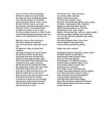
To sleep--perchance to dream: ay, there's the rub, Magada : ehk isegi und näha : selles see vastus seisnebki. For in that sleep of death what dreams may come Sest selles surmaunes, unenäod, mis võivad tulla When we have shuffled off this mortal coil, Kui me oleme endilt maha raputanud selle sureliku askelduste puntra Must give us pause. There's the respect Peavad meile puhkust andma. Seal on hirm That makes calamity of so long life. Mis teeb õnnetuse sellest pikast elust For who would bear the whips and scorns of Kuna kes taluks aja piitsutusi ja põlgust, time, Th' oppressor's wrong, the proud man's Rõhuja väära, uhke solvamist contumely The pangs of despised love, the law's delay, Äratõugatud armastuse valupisteid, seaduse viivitust The insolence of office, and the spurns Ametniku jultumust, ja halvakspanu,
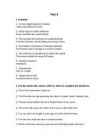
4 Roomlastel ei õnnestunud Sotimaad vallutada. The Romans didn´t manage to conquer Scotland. 5 See imeerium on eksisteerinud umbes 400 aastat. This empire existed foir about 400 years. 6 kohalikud elanikud inhabitants 7 lossivaremed ruins of a castle 8 restaureeritud mõis a restored manor house 2 Use the words who, whose, which or where to complete the sentences. 1 This is the house where I grew up. 2 The film which we saw yesterday was about a cowgirl called Calamity Jane. 3 The boy whose mother we met in Regent Street is my cousin. 4 This is the cafe where my mother has a cup of coffee after work. 5 Our car, which we bought 2 years ago, is a dark blue Mercedes. 6 The man who lives next door is a famous writer. 7 Where is the book which you gave me as a birthday present last year? 8 This is Sally, whose brother is the best footballer on our school team. 3 Make up sentences. 1 bike is man me mend my helped the this to who
mean they don't "find value" in it. For instance, when was the last time you personally chipped in for a clinical trial? And how are you paying for that air you're breathing right now? Some benefits are assumed to be part of the environment in which we exist. That's what it means to have an environment. If a benefit grows scarce to the point that people feel they must directly pay cash from their pocket to keep getting it, there's probably a far more dire calamity at hand than that single point of scarcity. Most people will almost always seek other free sources of a benefit first. The price of things is usually affected by it’s value. Since many people assume that higher priced items are better, they value the lower priced items less. I know many people who assume that a freeware program is inferior to a similar commercial program just because it's free. From time to time, things actually have no value, if you think about it. It’s the activity you
upstart. Disaster fell upon Portugal in the morning of 1 November 1755, when Lisbon was struck by a violent earthquake with an estimated Richter scale magnitude of 9. The city was razed to the ground by the earthquake and the subsequent tsunami and ensuing fires. Sebastião de Melo survived by a stroke of luck and then immediately embarked on rebuilding the city, with his famous quote: "What now? We bury the dead and take care of the living."Despite the calamity and huge death toll, Lisbon suffered no epidemics and within less than one year was already be ing rebuilt. The new downtown of Lisbon was designed to resist subsequent earthquakes. Architectural models were built for tests, and the effects of an earthquake were simulated by marching troops around the models. The buildings and big squares of the Pombaline Downtown still remain as one of Lisbon's tourist attractions. Sebastião de Melo also made an
90168). The revolutionaries of the new science had to escape their intellectual heritage [ pärandus ]. With this in mind, the revolution in science which emerged [ kerkis esile ] in the 16th and 17th centuries has appeared as a watershed in world history. The long term effects of both the Scientific Revolution and the modern acceptance and dependence upon science can be felt today in our daily lives. And not with standing some major calamity science and the scientific spirit will be around for centuries to come. There are numerous questions we could ask ourselves about the Scientific Revolution: why it occurred? what forces produced it? why was it so revolutionary? why was it stronger in the Protestant North? But to my mind, before we can even begin to cope with these questions we must ask a much more basic question: What is science?
date of the war is generally held to be September 1939 with the German invasion of Poland and declarations of war on Germany by the United Kingdom, France and the British Dominions. The Allies won the war, but suffered great loss. The United Nations was formed in the hope of preventing another such conflict. *The 'phoney war' It is the name given to the period of time in World War Two when, after the attack on Poland seemingly nothing happened. Many in Great Britain expected a major calamity but the title `Phoney War' summarises what happened in Western Europe near enough nothing. In Western Europe very little of military importance did take place. In fact, so little occurred that many of the children who had been evacuated at the start of the war, had returned to their families. In fact, things were happening but the public in Britain were not aware of them. *Battle of Britain 1940, El Alamein 1942, Singapore 1942 Battle of Britain is the name
The slings and arrows of outrageous fortune, Or to take arms against a sea of troubles, And by opposing end them? To die: to sleep; No more; and by a sleep to say we end The heart-ache and the thousand natural shocks That flesh is heir to, 'tis a consummation Devoutly to be wish'd. To die, to sleep; To sleep: perchance to dream: ay, there's the rub; For in that sleep of death what dreams may come When we have shuffled off this mortal coil, Must give us pause: there's the respect That makes calamity of so long life; For who would bear the whips and scorns of time, The oppressor's wrong, the proud man's contumely, The pangs of despised love, the law's delay, The insolence of office and the spurns That patient merit of the unworthy takes, When he himself might his quietus make With a bare bodkin? who would fardels bear, To grunt and sweat under a weary life, But that the dread of something after death, The undiscover'd country from whose bourn No traveller returns, puzzles the will
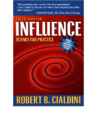
another initially baffling case. On May 27, 2007, a Washington, DC-based gov- ernrnent official named Christiaan Kroner spoke to a news reporter with uncon- cealed pride in the governmental action that had followed the Hurricane Katrina disaster, detailing how "pumps, ships, helicopters, engineers, and humanitarian relief" had been sent both rapidly and adeptly to the flooded city of New Or- leans and to many other sites of the calamity (Hunter, 2007). Say what? In the face of widespread recognition of the Federal government's scandalously delayed and monstrously inept reaction to the tragedy, how could he possibly make such a statement? For example, at the time of his claim, the government's vaunted Road Home program designed to aid Louisiana homeowners still hadn't deliv- ered funds to 80 percent of those requesting assistance, even though nearly eigh- teen months had past. Could it be that Mr
 annaabi.ee