arranged "Mystery of Stonehenge" Multiplicity of theories: Stonehenge was domain of the dead, Woodhenge was land of the living. Place of healing. Observatory, temple Used for astronomical views. Construction Three periods: Period I (c. 2950-2900 BC) - circular enclosure (56 Aubrey holes and 4 Station Stones inside it), outlined by two banks, ditch with an entrance to the northeast, heel stone, Period II (c. 2900-2400 BC) - unclear, (bluestones were brought in, post-holes were used to create a structure) Period III (c. 2550-1600 BC) - 1 circle of sarsen-stones and in it 2 circles of bluestones, (Altar Stone was placed), horseshoe-shaped setting of 5 sarsen trilithons (opening pointing to the northeast side) Stonehenge tour No Dogs Audio tour Admission prices: Adult £6.50 Concession £5.20 Child £3.30 Family £16.30
o The Wessex people o The Welsh o The Phoenicians Why was Stonehenge built? o for ceremonial burial ground ? o for ancient astronomical calendar? o as a temple for religious ceremonies? o as a cosmic temple dedicated to all twelve gods of the zadiac? o as a dance venue for prehistoric raves ? o as a source of healing energy? o as an eclipse calculator? o as an UFO landing site? The sandstones weigh up to 25 tons each and 30 were used. The bluestones weigh up to 4 tons each and 80 were used in all The sarsen stones weight up to 50 tons each Interesting theories theory nr.1 stonehenge is leftovers from the first Theory nr.2 orginally stonehenge was a game ever played symbol of peace Click to edit Master text styles Second level
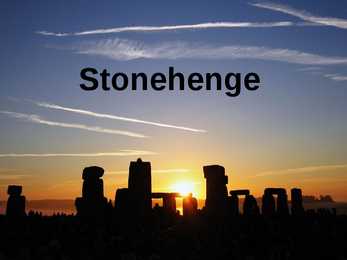
· a tribal gathering place or religious centre, kind of a temple worship gods · burial ground, perhaps for royalty · observatory - connected with astronomical observations, the Sun and the Moon · the direction of sunrise on the longest day of the year · 21st June -the summer solstice · could have been used to predict the summer and winter solstices · healing center - bluestones · Aliens? Stonehenge Today · The monument still inspires awe and admiration · attracts some 800,000 visitors a year · managed by English Heritage · became a World Heritage Site in 1986 · on the summer Solstice, thousands of people gather to watch the sunrise · the stone circle witnessed many druidic ceremonies, especially during the 19th century · today, much work goes on behind the scenes to ensure that Stonehenge and its unique
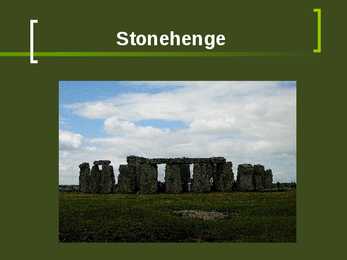
large standing stones. It is at the centre of the most dense complex of Neolithic and Bronze Age monuments in England, including several hundred burial mound. Archaeologists have believed that the iconic stone monument was erected around 2500 BC, as described in the chronology below. One recent theory however, has suggested that the first stones were not erected until 24002200 BC, whilst another suggests that bluestones may have been erected at the site as early as 3000 BC (see phase 1 below). The surrounding circular earth bank and ditch, which constitute the earliest phase of the monument, have been dated to about 3100 BC. The site and its surroundings were added to the UNESCO's list of World Heritage Sites in 1986 in a colisting with Avebury Henge monument. It is a national legally protected Scheduled Ancient Monument. Stonehenge is
ramp. Wooden stakes were used to reinforce the other sides of the hole. 140 200 workers would pull the stone upright perhaps using a pulley. The hole was filled with rocks and boulders packed tightly together. Mortise, tenons, and toggle joints were used to hold the lintels and sarsens together. Why?? Theories-why was it built? Predict astronomical events. 30 sarsens in the circle could symbolize the days of the month 19 bluestones in the horseshoe could be the 19 year cycle of the moon Aligned with the midsummer sunrise and midwinter sunset Sacred site Who built it?? Merlin, the magician in King Arthur's time moved the stones to honor soldiers Built by Roman invaders Druids No one really knows the answer. Vandalism through the ages Romans ruined part of it when they were destroying pagan sites Stones were removed for bridges, houses, other building Continual touching has
2 kilometres (2.0 mi) west of Amesbury and 13 kilometres (8.1 mi) north of Salisbury. One of the most famous prehistoric sites in the world, Stonehenge is composed of earthworks surrounding a circular setting of large standing stones. Archaeologists had believed that the iconic stone monument was erected around 2500 BC, as described in the chronology below. However one recent theory has suggested that the first stones were not erected until 2400-2200 BC,[1] whilst another suggests that bluestones may have been erected at the site as early as 3000 BC (see phase 1 below). The surrounding circular earth bank and ditch, which constitute the earliest phase of the monument, have been dated to about 3100 BC. The site and its surroundings were added to the UNESCO's list of World Heritage Sites in 1986 in a co-listing with Avebury henge monument, and it is also a legally protected Scheduled Ancient Monument. Stonehenge itself is owned by the Crown
 annaabi.ee