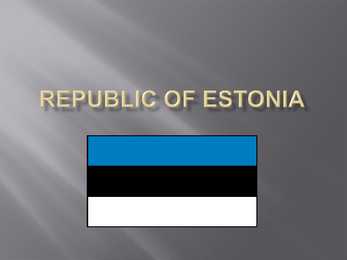
Estonia Location Estonia officially the Republic of Estonia is a state in the Baltic region of Northern Europe. It is bordered to the north by the Gulf of Finland, to the west by the Baltic Sea, to the south by Latvia and to the east by the Lake Peipsi and the Russian Federation. Across the Baltic Sea lies Sweden in the west and Finland in the north. Size and population The territory of Estonia covers 45,227 km2 Estonian population is 1.34 million Largest cities of Estonia 1. Tallinn (Estonian capital city) 2. Tartu 3. Narva 4. Kohtla-Järve Tallinn Tartu Narva Kohtla-Järve Largest islands of Estonia There are 1521 islands. 1. Saaremaa 2. Hiiumaa 3. Muhu 4. Vormsi Hiiumaa Saaremaa Vormsi Muhu Longest river of Estonia 1. Võhandu 2. Pärnu 3. Põltsamaa Võhandu river Põltsamaa river Pärnu river Estonian seasons There are four se...
Bilberry Bilberry Bilberry is any of several Eurasian species of low-growing shrubs, bearing edible, nearly black berries. Bilberries are distinct from blueberries but closely related to them. Bilberryis a plant. The dried, ripe fruit and leaves are used to make medicine. Bilberriesare found in very acidic, nutrient-poor soils throughout the temperate and subarctic regions of the world. Are related to North American wild. It can be picked… Bilberryhas sharp-edged, green branches and black berries, which are ripe for picking in late summer. How it is used Bilberryis used for improving eyesight, including night vision. Some people use bilberry for conditions of the heart. Bilberryis also used for chronic fatigue syndrome, hemorrhoids, diabetes, gout, skin infections, kidney disease, and urinary tract infections. In Finland, Estonia, Russia bilberries are collected from forests. Bi...
The area of Estonia is 45 227 sq km it's bigger than Denmark, Switzerland and Holland. Population an estimated 1 364 100 people and 30 people per sq km. Capital of Estonia is Tallinn. Population in Tallinn is about 397 150 people over a third of the nation. The biggest cities are Tartu, Narva and Pärnu. 70% of Estonians live in towns. All of the towns are old. · Estonia has 7000 rivers and streams. · Forests comprise slightly under half on Estonia's territory. · Scots pine, spruce, birch, aspen and alder are the most popular in the forest. · There are also a lot of animals: elks, roe deers, boars, brown bears, wolves etc. · About 10% of Estonia is a nature reserve. Estonians speak Estonian. It is used as a mother tongue by just under 1.1 million people. Estonian is one of the world's smallest cultural lan...
Traditional Estonian food has its roots firmly in the countryside, relying heavily on pork, potatoes and garden variety vegetables. The main culinary influences were from Germans, who ruled over Estonia for so many centuries. The eating habits of the Estonian population are related to the season, which severely affect the availability of fresh food. The spring and summer are the seasons of fresh food, in this period are used vegetables, berries and herbs, with the warmer climate the Estonians also like to cook meat grilled outdoors. During the winter are used mushrooms, jams, and preserved foods. Among the typical Estonian dishes are: Baltic fish in acid sauce, pork with sauerkraut and boiled potatoes, blood sausage and barley, marinade anguilla, boiled pork in jelly, tongue, smoked fish and a kind of dry cake-like barley bread. Milk and all kinds of dairy products such as fermented milk, yogurt and various dishes made with rennet are ...
KRISTALLMETS Skulptuur “Kristallmets” kujutab puidust modelleeritud kristalle, mille tipud on värviliseks maalitud. Enamasti peetakse ühe maa väärtuslikeks varadeks kulda, hõbedat või teemante. Kahjuks Eesti riigis neid maapõues ei leidu, kuid meil on siiski midagi, mida peaksime enam väärtustama ja millele rohkem tähelepanu pöörama - nimelt puit. Mets katab kuni 55% meie riigi territooriumist, täna veel… See number võib aga kiirelt kahanema hakata, kui me targasti oma metsi ei majanda. Korralik mets kasvab keskmiselt 70 aastat. Noored, kes täna oma talu maadele metsa istutavad, seal sirgunud palkidest endale tõenäoliselt maja ei ehita, pigem nende lapsed või lapselapsed. Unistame Eestist, kus ka meie laste lapsed teaksid, mis on mets ja saaksid seal igal ajal jalutada, marju korjata või talvel suusatamas käia. Soovisime mitte raisata seda, mille hoidmisele tähelepanu tahame juhtida. Seepärast kasutasime oma töös meie kodukandi puidut...
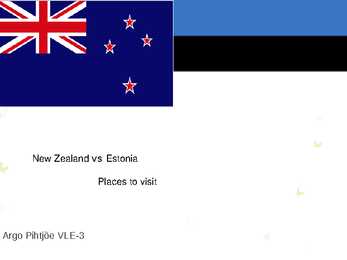
New Zealand vs Estonia Places to visit Argo Pihtjõe VLE-3 Some facts: Full name: Republic of Estonia Full name: New Zealand Population: 1.3 million (UN, 2010) Population: 4.3 million (UN, 2010) Capital: Tallinn Capital: Wellington Area: 45,227 sq km (17,462 sq miles) Area: 270,534 sq km (104,454 sq miles) Major languages: Estonian Major languages: English, Maori Major religion: Christianity Major religion: Christianity Life expectancy: 69 years (men), 79 Life expectancy: 79 years (men), 83 years (women) (UN) years (women) (UN) Monetary unit: euro Monetary unit: 1 New Zealand dollar Main exports: Machinery, textiles, wood ($NZ) = 100 cents products Main exports: Wool, food and dairy GNI per capita: US $14,060 (World...
Economy of Estonia The economic growth during the recent years has been very fast. The Estonian economy is diverse industry and transport, as well as commerce and different branches of services are all equally important. Due to the available natural resources Estonian economy largely relies on the branches related to the forest; Estonian energy sector is based on oil shale. Finland and Sweden are the most important trade partners. The Estonian economy profits significantly from the business generated by more than 2 million tourists a year. The important sectors of the Estonian economy are the processing, transport, warehousing and communications, commerce and estate, rental and letting, as well as business services, agriculture, construction and government, education and health care. In order to be able to import all the products and services, something must be exported, that's why export holds such a prominent posit...
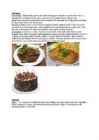
Estonian cuisine The traditional cuisine of Estonia has substantially been based on meat and potatoes, and on fish in coastal and lakeside areas, but is influenced by many other cuisines by now. In the present day it includes a variety of international foods and dishes, with a number of contributions from the traditions of nearby countries. German, Scandinavian, Russian and other influences have played their part. The most typical foods in Estonia have been rye bread, pork, potatoes and dairy products. Estonian eating habits have historically been closely linked to the seasons. In terms of staples, Estonia belongs firmly to the beer, vodka, rye bread and pork "belt" of Europe. The Cold Table Flounder The first course in traditional Estonian cuisine is based on cold dishes - a selection of meats and sausages served with potato salad or Rosolje, an Estonian signature dishes based on beetroot, meat and herring ...
Estonian Economy Estonians earn about half of the average European income, despite the fact that the economic growth during the recent years has been very fast and the differences have been diminishing. Although the extremely vigorous period of economic reforms is now over, the changes that Estonia is presently going through are far more extensive than those in the developed countries. The Estonian economy is diverse industry and transport, as well as commerce and different branches of services are all equally important. Due to the available natural resources Estonian economy largely relies on the branches related to the forest; Estonian energy sector is based on oil shale, a resource quite rare elsewhere in the world. Finland and Sweden are the most important trade partners. The Estonian economy profits significantly from the business generated by more than 2 million tourists a year, most of who...
German Sauerbraten: Traditionally made with a beef roasting joint (topside or similar) the meat is marinated for 2-3 days in beer, spices such as cloves, juniper berries, allspice and peppercorns, bay leaves and onions and is braised in the marinade for a long period, resulting in very tender melt-in-the-mouth meat. The Black Forest: cake is one of the most popular German national foods. Cake consists of several layers of chocolate cake, with whipped cream and cherries between each layer. Then the cake is decorated with additional whipped cream and chocolate shavings. A Schnitzel in German is a slice of pork or veal haunch. Dish made with boneless meat thinned with a mallet (escalope-style preparation), coated in bread crumbs and fried. Only if it is made of veal and coated in bread crumbs is it called Wiener Schnitzel; a pork version is called Schnitzel Wiener Art (Viennese type schnitzel). These are served with a slice of lemon and wi...
Forestry Importance: · Environmental-protective importance Oxygen Cleans the air/soils/ground water Protects the soil from erosion · Timber Firewood Woodwork Building materials Timber cellulose paper · Mushrooms/berries/juices · Habitat of different species Measuring the amount of forest: · Fixing the area under the forests (ha/%) -> In Estonia 47.4%, 2.143 mil/ha It doesn't take into account the amount of timber · To measure the amount of timber (m3) -> 352.7 mil/m3 It doesn't take into account the annual increase · To fix different species of trees (%) -> Pine 40%, Birch 30%, Spruce 20% · To measure the annual increase of timber (m3, ha, year) -> 9 mil. m3/ha/year Main principle of the economy of forests: Annual cutting should be equal to annual increase. Trees are divided into: · Precious trees (ebony, mahagony, sandalwood) · Hard-br...
1. Loopealsed 2. Nõmmemetsad 3. Palumetsad 4. Laanemetsad 5. Salumetsad 6. Soovikumetsad 7. Rabastuvad metsad 8. Rohusoometsad 9. Samblasoometsad 10. Kõdusoometsad ALVAR FORESTS LOOPEALSED METSAD This groupof types includes forests of low productivity and with a peculiar xeromesophilous ground vegetation, which grow on a layer of limestone, gravel, grit or shingle. See metsa kasvukohatüüp sisaldab madala tootlikkuse ja iseloomulikult suure või keskmise kuivusnõudlikkusega alustaimestikku, mis kasvab pae-, kruusa- , peenkruusa või klibukihil. This layer is close to surface, with thickness of soil up to 30 centimetres. See rinne on maapinnale lähemal, mullatüsedus on kuni 30 sentimeetrit. Alvar forests grow mainly in western Estonia (also on the islands) and to a lesser extent in Northern Estonia. Loopealsed metsad kasvavad peamiselt Lääne-Eestis (samuti saartel) ning vähemal määral P...
MODULE 1 Greeting. Introducing oneself and the others. The alphabet. Spelling. The tenses. How to introduce yourself and others Formal introductions How to respond and reply to an May I introduce myself? I am John introduction Smith. How do you do. Allow me to introduce John Smith to Pleased to meet you. you. Standard introduction Nice to meet you. I'd like you to meet John Smith. Hello. I want you to meet John Smith. I'm so pleased to meet you. This is Jane Smith. I'm Jane Smith. My name's John Smith. Informal introduction Hi. John. Jane. Hello. Titles: Mr Mrs Miss Ms Ms is a modern form of address for women. It replaces the traditional forms of Mrs and Miss. Greetings Good morning/afternoon/evening...
 annaabi.ee