Population- 49 446 600 (2004) National flag of England Coat of arms of England Rose · The Tudor rose is the national floral emblem of England, and was adopted as a national emblem of England around the time of the Wars of the Roses. Anthem · England does not have an official designated national anthem, as the United Kingdom as a whole has " God Save the Queen". However, the following are often considered unofficial English national anthems: · "I Vow to Thee, My Country" · "Land of Hope and Glory" · "Nimrod" · "Jerusalem" · "Heart of Oak" Climate · England has a temperate climate, with plentiful rainfall all year round, although the seasons are quite variable in temperature. However, temperatures rarely fall below -5 °C (23 °F) or rise above 30 °C (86 °F). Ethnic groups (2006) · 89% White 6% South Asian 3% Black 2% Mixed race 1% Chinese 1% Other Map of England The end
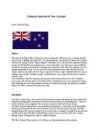
It has a quartered shield. In the first quarter there are four stars, representing the Southern Cross constellation. In the second quarter, there is a golden fleece representing the farming industry, in the third, a wheat sheaf representing agriculture, and in the fourth two hammers representing mining and industry.. The shield is supported by the European woman and a Maori man. And above the shield there is Edvard's Crown. God Defend New Zealand is one of the national anthems of New Zealand. God Save the Queen is one of the national anthems of New Zealand. Kiwi - it is a flightless bird that live in New Zealand. Kiwiana Public holidays 2010 1 Jan - 2 Jan New Year. 6 Feb Waitangi Day. 2 Apr - 5 Apr Easter. 25 Apr ANZAC Day. 7 Jun Queen's Birthday. 27 Oct Labour Day. 25 Dec Christmas Day. 26 Dec Boxing Day. New Zealand topic
He also created the Africanism project, where an ensemble of artists produce house music with a combination of Latin, jazz, African and tribal flavours. In 2005 he scored a hit with the single "Love Generation", that reached #1 on the Australian ARIA Singles Charts and the German Media Control Single Charts in 2006. The song was a huge success throughout Europe, also peaking at no. 2 in the Dutch Top 40 and it stood 39 weeks in the Ultratop 50 in Belgium. It became one of the official anthems for the World Cup 2006 held in Germany. The followup hit was "World, Hold On", that features Steve Edwards and also managed to chart in the top ten in most of the European countries. "Rock This Party (Everybody Dance Now)" followed on 22 August 2006. The remix of "World, Hold on" by ESmoove was nominated for a Grammy in 2007 in the category of Remixed Recording. Also, "World, Hold On" topped in Billboard Magazine as Number One Hot Dance Club Play
rhymes with month, orange, silver or purple • The shortest war in history was between Zanzibar and the UK in 1896. Zanzibar surrendered after 38 • French was the official language of minutes. England from 1066 to 1362. • British police do not carry guns except in emergencies. • An Englishman drinks more tea than any person of any other nation. Anthems UK(United Kingdom) Ireland • http:// www.youtube.com/watch?v=ysXPUg8 GLQ0 • http:// www.youtube.com/watch?v=tN9EC3G • The music was composed by Pedar y6Nk Kearney and Patrick Heeney. • The author of the tune is unknown, • The song has three verses, but only the
But fox-hunting is part of country life. It's one of our traditions. But public transport is expensive and inconvenient. But English has borrowed from the Romans, the Vikings, the Saxons and the French But freight trains can't deliver goods from door to door But who can say that we will develop into civilized beings? Surely, God has the right to cut his losses! But why play the gold medalists' national anthems and why wear stars and stripes on your swimming costumes? But if you worked on a farm and your chickens were killed by foxes, you'd think differently. But if you detect more crimes, you'll still need prisons. But if you followed that line to its logical conclusion, you'd pardon all criminals. But surely, you can see what you're getting in the holiday brochure. But surely, if you raise benefits too high, people wouldn't bother to work.
national occasions, for example Royal Visits, and Jubilee celebrations provided the display is not a permanent feature. Use of the Arms may be permitted on permanent souvenirs of a particular event, for example a Royal Anniversary or Visit. Advice of permission to use the Arms in this manner is published in the New Zealand Gazette. Publishers of encyclopaedia, educational and heraldry books may be granted permission to reproduce the Arms in certain circumstances. New Zealand's National Anthems The words for "God Defend New Zealand" were written as a poem in the 1870s by Irish immigrant Thomas Bracken. A competition to compose music for the poem was held in 1876. The winner of the competition was John Joseph Woods of Lawrence, New Zealand who composed the melody in a single sitting the evening after finding out about the competition. The song became increasingly popular during the 19th century and early 20th century, and in
every four years, organised by the International Olympic Committee. The Olympics are the most prestigious of such events in the world. Olympic victory is widely considered to be the most prestigious achievement in sports. Medals are awarded in each event, with gold for first place, silver for second and bronze for third, a tradition which started in 1904. Competitors are entered by a National Olympic Committee (NOC) to represent their country of citizenship. National anthems and flags accompany the medal ceremonies, and tables showing the number of medals won by each country are widely used. In general only recognised nations are represented, but a few non- sovereign countries are allowed to take part. The special case of Taiwan was handled by having it compete as Chinese Taipei, to avoid the issue of Taiwanese independence. Though the most diverse sporting event in the world, the Olympics are perhaps not the most popular
England, but it was not until 1707 that the Parliaments of the two countries agreed to form a single kingdom. Subsequently, in 1801, Great Britain united with the neighboring Kingdom of Ireland, forming the United Kingdom of Great Britain and Ireland. When five-sixths of Ireland seceded from the United Kingdom in 1922, the state was renamed the United Kingdom of Great Britain and Northern Ireland. 1.2 National Symbols and Nation Building The nation is visible through its symbols (flags, anthems, emblems), ceremonies (national days, sporting events), monuments (memorials, buildings, national museums), the land itself (landscape), its borders (insiders and outsiders) and the capital city. This assumption is illustrated by the fact that all nations, in order to be accepted internationally, must have a certain number of characteristics. The nation is usually known by six essential elements: a name, a capital city,
 annaabi.ee