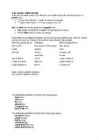
A few and few, a little and little A few (for countable nouns) and a little (for uncountable nouns) describe the quantity in a positive way: · "I've got a few friends" (= maybe not many, but enough) · "I've got a little money" (= I've got enough to live on) Few and little describe the quantity in a negative way: · Few people visited him in hospital (= he had almost no visitors) · He had little money (= almost no money) Some adjectives and adjectival phrases can only go with uncountable nouns (salt, rice, money, advice), and some can only go with countable nouns (friends, bags, people). With Uncountable Nouns With Both With Countable Nouns How much? How much? or How many? How many? a little no/none a few a bit (of) not any a number (of) some (any) several
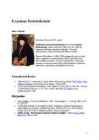
Fanatism - fanaatikule omane kirglik andumus, pühendumus Fanaatik - millegi kirglik kaitsja v harrastaja Teoloogia usuteadus His scholarly name Desiderius Erasmus Roterodamus comprises the following three elements: the Latin noun desiderium ("longing" or "desire"; the name being a genuine Late Latin name); the Greek adjective (erásmios) meaning "desired", and, in the form Erasmus, also the name of a saint; and the Latinized adjectival form for the city of Rotterdam (Roterodamus = "of Rotterdam"). Erasmus was a classical scholar who wrote in a "pure" Latin style and enjoyed the sobriquet "Prince of the Humanists." He has been called "the crowning glory of the Christian humanists." 2 Sünge noorus Erasmus sündis ühes Hollandi linnas Rotterdamis 27. oktoobril 1469 (või 1466)
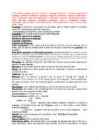
19. Suffixes A suffix is an affix that follows its base. An element placed at the end of a word to form a derivative, such as –ation, -fy, -ing, frequently one that converts the stem into another part of speech. While the prefixes do not change anything in the pronunciation of shape of the base words, the suffixes have such an effect. They lead either to the deletion of material at the end of the base or to a different stress pattern Adjectival 7 o Relational - to relate the noun the adjective qualifies to the base word of the derived adjective Algebraic, colonial, theoretical o Qualitative - express more specific concepts Grammatical o Some relational adjectives can adopt qualitative meanings.
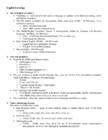
as soon as, as if, as though, in case, etc. Types of subordinate clauses: - nominal clauses - relative clauses - adverbial - comment Formal indicators of subordination: (i) a subordinating conjunction. (ii) a wh-element. (iii) inversion. (iv) The verb element is either non-finite or absent. Syntactic functions of subordinate clauses: - subject - direct object - indirect object - subject complement - object complement - adverbial - postmodifier in NP - prepositional complement - adjectival complementation Types and functions of subordinate clauses: Nominal clauses: - that-clauses - wh-interrogative clauses - yes-no and alternative interrogative clauses - exclamative clauses - nominal relative clauses - to-infinitive clauses - -ing clauses - bare infinitive clauses - verbless clauses Adverbial clauses: - clauses of time - clauses of place - clauses of condition, concession, and contrast - reason clauses - purpose clauses - result clauses - clauses of similarity and comparison
believes that Irma believes that the house is burning down." How would we write a truth rule for it? "n believes that A" is true if and only if . . . " what? One obvious strategy is to invoke a domain of helpful entities, such as propositions(!), and write truth rules for non-truth-functional expressions in terms of quantification over that domain. (As we have seen, to deal with some adverbs, Davidson introduced a domain of "events," and made adverbs into adjectival predicates of events.) The main problem with that strategy is that it strains syntax, since the transformations have to work harder to transform the new, zany logical forms into familiar English; as Blackburn points out (1984: 289), a Davidsonian treatment of a non-truth-functional (and intensional) construction such as "because" or "believes that" requires at least a "heavy commitment to concealed logical forms." (But, as before,
 annaabi.ee