you are playing this. Remember your index finger is number 1, you middle finger is number 2, your ring finger is number 3 and your pinky is number 4. Play in down strokes and take your time. Try and make each note ring clear. Remember it is better to play slowly and accurately than to sound muddy and unclear. Video and Audio Available: Dial Up Broadband QuickTime - Exercise 1 (930 KB) QuickTime - Exercise 1 (2.53 MB) WindowsMediaPlayer - Exercise 1 (1.96 WindowsMediaPlayer - Exercise 1 (3.48 MB) MB) Audio Audio mp3 - Exercise 1 (489 KB) Now that you have finished that warm up pattern it's time to move onto the main part of the lesson which is some work on strumming. Before you start on this I am going to explain some simple music theory to you. Don't get intimidated by this as it is pretty simple. You may or may not have noticed that most of the things you have played
worry about at this stage, but it is something you should be aware of. Try the exercise below and remember to take a look at the video if you have any problems: G major chord Tip: You can download a video or audio example of the above exercise to see and hear it for yourself. The download links are below (right click on the link and select "save as"): Dial Up Broadband QuickTime - Exercise 1 (850 KB) QuickTime - Exercise 1 (2.30 MB) WindowsMediaPlayer - Exercise 1 (1.48 WindowsMediaPlayer - Exercise 1 (2.80 MB) MB) Audio Audio mp3 - Exercise 1 (495 KB) As you can see the difference between practicing this chord and the previous chords you have learned is that you are doubling up on the strum. The way I would like you to do this is by strumming up when you bring your hand back up. Take your time with this. Watch the video provided and try and play along. Your strum should be constant and in time
the thinnest string once with your plucking hand and do nothing with your fret hand. Tip: If you are having trouble with this concept, you can download a video or audio example of the above exercise to see and hear it for yourself. The download links are below (right click on the link and select "save as"): Dial Up Broadband QuickTime - Exercise 1 (503 KB) QuickTime - Exercise 1 (1.39 MB) WindowsMediaPlayer - Exercise 1 (714 WindowsMediaPlayer - Exercise 1 (1.7 KB) MB) Audio Audio mp3 - Exercise 1 (308 KB) Now let's see if we can start pushing down some strings. Look at the next example below and try and play the note that the TAB chart displays. If you pressed down the thickest string at the 3rd fret then you played the exercise correctly. If you are still unsure whether you are doing the right thing or not, refer to the video below.
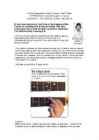
While you play this, see if you can say out loud an even 4 count. Another option if you are a Jamorama.com member is to use the jamorama metronome - it will help you to stay in time. Tip: You can download a video or audio example of the above exercise to see and hear it for yourself. The download links are below (right click on the link and select "save as"): Dial Up Broadband QuickTime - A Major (1.56MB) QuickTime - A Major (4.00MB) WindowsMediaPlayer - A Major (1.76MB) WindowsMediaPlayer - A Major (5.87MB) Audio A Major Mp3 (0.75MB) Try your best to start your strum from the fifth string each time you strum. A major, doesn't sound bad if you accidentally hit the top string, although if you want your music to sound professional, you'll want to play this chord properly. Remember to stay relaxed. Your fingers may hurt a little but they will get stronger. Now that you are playing the A major chord properly, let's take a look at
This one will be a touch more difficult than the last few. This pattern starts on the first fret and the sixth string (thickest string). You will play all six strings and use all your fingers. As always with these exercises, I would like you to use the correct fingering. Warm up: Video and Audio Available: Dial Up Broadband QuickTime - Exercise 1 (1.25 MB) QuickTime - Exercise 1 (3.35 MB) WindowsMediaPlayer - Exercise 1 (2.79 WindowsMediaPlayer - Exercise 1 (4.54 MB) MB) Audio Audio mp3 - Exercise 1 (712 KB) In the above warmup, you will have noticed that the frets you play have the same numbers as the fingers you use. This should make it easy to remember what to play. So now after playing that, your fingers should be warmed up and ready to play. Let's move onto learning 'The Midnight Special'... As you already know how to play the chords and the strum for the song, all we
 annaabi.ee