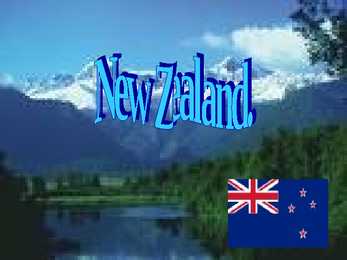
Welfare state and a protectionist economy. Flora and fauna . · New Zealand has extraordinary flora and fauna. · About 80% of the New Zealand flora occurs only in New Zealand. · Until the arrival of humans, 80% of the land was forested. The two main types of forest are those dominated by podocarps including the giant kauri, and in cooler climates the southern beech. · The remaining vegetation types in New Zealand are grasslands of tussock and other grasses, usually in sub-alpine areas, and the low shrublands between grasslands and forests. · Unique birds capable of flight include the Haast´s eagle, which was the world's largest bird of prey (now extinct), and the large kaka and kea parrots. · Reptiles present in New Zealand include skinks, geckos and tuatara. · There are four endemic species of primitive frogs. · There are no snakes and there is only one venomous spider, the katipo, which is rare and
44 wetter community types. But statistically it was different in different management regimes species pool decreased from regime A towards regime D. In the unsystematically mowed areas (B and C regime), and in areas that had not been mowed for a long time (D regime), dominated herbs. Mat-forming graminoids were abundantly represented in the unsystematic regime areas. Both on regularly mowed areas and long-time unmown areas dominated tussock-forming graminoids, but they differed for species and size. In case of regular mowing they were graminaceous growing in lower herb layer, in unmown areas they were species that form large dwarf shrubs like tussock grass and tussock sedge. 45 TÄNUAVALDUSED Töö autor tänab prof. Tõnu Oja magistritöö ja kaarditöötluse juhendamise eest. Eriline tänu kuulub veel MSc
 annaabi.ee