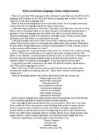
'' And it's hard to translate these things, because some of the message will be lost because of the word-play and diffrent cultures understand words diffrently. Our knowledge of herbs and medication lies in our memories. There aren't very many books, which talk about our ancestors' ways of healing. How would we know that our ancestors used aconitum ( known as aconite, monkshood, wolfsbane, leopard's bane, women's bane) in case of a tumour and at the beginning of a cold, Lichen Islandicus for fever, cold, tuberculosis, calendular salve on wounds, trefoils' tea for cough and put a hop inside a pillow in case of a sleep deprivation, if our ancestors hadn't taught that to us. When my stomach hurt, my mother used to read those lines to me: '' Kiirmus-kaarmus Varesele valu Harakale haigus
The substance may cause effects on the blood, resulting in the formation of methaemoglobin. Exposure at high levels may result in death. Repeated or prolonged contact may cause skin sensitization. The substance may have effects on the blood, resulting in formation of methaemoglobin. Tends to accumulate in the body, especially in bladder. Often leads to bladder cancer. Aniline was tested on animals, but in mice was observed no increase in tumour incidence, in rats, it produced fibrosarcomas, sarcomas and haemangiosarcomas of the spleen and peritoneal cavity. 4. Behavior in the wild Not found in nature. If appears, starts oxidation. In reactions localized at nitrogen or more commonly results in the formation of new C-N bonds. In alkaline solution, azobenzene results, whereas arsenic acid produces the violet-coloring matter violaniline. Chromic acid
G, Brown J, Siemiatycki J, Parent ME, Nadon L, Krewski D, McBride ML, Johansen C, Collatz Christensen H, Auvinen A, Kurttio P, Lahkola A, Salminen T, Hours M, Bernard M, Montestruq L, Schüz J, Berg-Beckhoff G, Schlehofer B, Blettner M, Sadetzki S, Chetrit A, Jarus-Hakak A, Lagorio S, Iavarone I, Takebayashi T, Yamaguchi N, Woodward A, Cook A, Pearce N, Tynes T, Blaasaas KG, Klaeboe L, Feychting M, Lönn S, Ahlbom A, McKinney PA, Hepworth SJ, Muir KR, Swerdlow AJ, Schoemaker MJ. 2010. Brain tumour risk in relation to mobile telephone use: results of the INTERPHONE international case-control study. International journal of epidemiology 39, 675-694 3. C.I.A. 2009. The World Factbook. Kättesaadav:https://www.cia.gov/library/publications/the-world-factbook/rankorder/2151 rank.html [külastatud 3. november 2010]. 4. De Iuliis GN, Newey RJ, King BV, Aitken RJ. 2009. Mobile phone radiation induces reactive oxygen species production and DNA damage in human spermatozoa in vitro. Public
 annaabi.ee