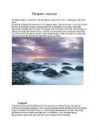
The giant's causeway Northern Ireland is a beautiful. The most famous sight is the Giant' s causeway on the north coast. According to legend, the columns are old stepping stones, that giants used to cross the channel between ireland and Scotland. Although there are an abundance of tall tales, and myths describing colourful ways the Giant's Causeway came into being, the actual, natural history is a bit less exciting. The actual history is that the rock formations were created by a lava flow some 65 million years ago by molten basalt rising through a chalk bed, and then cooling and cracking to form the tall columns that make up the causeway. Legend: Legend has it that the Finn McCool built the causeway to walk to Scotland to fight his Scottish counterpart Benandonner. One version of the legend tells that Fionn fell asleep before he got to Scotland. To protect Fionn, his wife Oonagh laid a blanket over h...
The Giant ´s Causeway 1. What does the legend say who made it? A giant 2. What does it look like? Huge stairs 3. According to legend, why was it made? To cross the sea 4. What is it made of? Stones 5. how high are the tallest stones? 12 metres Loch Ness 1. Where is it? In Scottland 2. Why does it have name like this? A monster ´s name ( Ness ) Loch means lake 3. How deep is the deepest point? 266 metres 4. Loch Ness is having one island, what ´s it ´s name? Cherry 5. What do people every year organize in Loch Ness? Running competition Stonehenge 1. When did people build it? About 5500 years ago 2. How did people transport those stones? With rafts 3. What do people think why is it built? For astrology 4. Local people think that there is a magical power. What power? It can heal people 5. Where are the stones from? ...
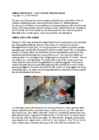
AMBER AND RUSSET - LATE COLOUR CHANGE GENES Copyright 2014, Sarah Hartwell The ancestors of the domestic cat were nondescript black/brown striped tabbies. Over the centuries, mutation produced a wide array of colours based on 2 different pigments. Eumelanin gives the blacks, browns and blues while phaeomelanin gives the reds, fawns and creams. A few other genes give further variations on those colours such silvers, colourpoints and solids/selfs. Mutations continue to occur and unexpected colours also turn up due to inbreeding where recessive genes, hidden for generations, start showing up. AMBER AND LIGHT AMBER During the 1990s, some purebred Norwegian Forest Cats in Sweden produced chocolate/lilac and cinnamon/fawn offspring. However, those colours are not found in the purebred Norwegian Forest Cat gene pool. Had the gene pool become polluted by someone, perhaps generations ago, breeding their Norwegian Forest Cat to another breed? ...
 annaabi.ee