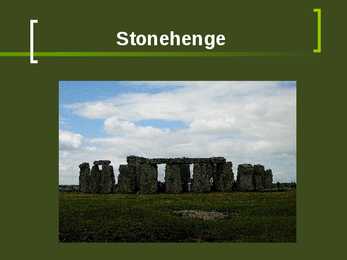
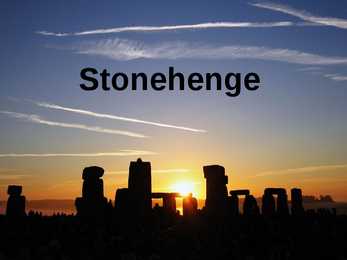
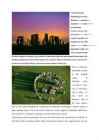
Place of healing. Observatory, temple Used for astronomical views. Construction Three periods: Period I (c. 2950-2900 BC) - circular enclosure (56 Aubrey holes and 4 Station Stones inside it), outlined by two banks, ditch with an entrance to the northeast, heel stone, Period II (c. 2900-2400 BC) - unclear, (bluestones were brought in, post-holes were used to create a structure) Period III (c. 2550-1600 BC) - 1 circle of sarsen-stones and in it 2 circles of bluestones, (Altar Stone was placed), horseshoe-shaped setting of 5 sarsen trilithons (opening pointing to the northeast side) Stonehenge tour No Dogs Audio tour Admission prices: Adult £6.50 Concession £5.20 Child £3.30 Family £16.30
water and land from Wales Half of the stones were probably from 24 miles away A phenomenal feat to move them!! How were the stones moved? Great debate by historians and archeologists Primitive tools made from deer antlers or stones were used to pry the stone out of the ground Long poles were used as levers to lift the stone onto a sledge Ropes of hide were used to drag the stones Question How many people do you think it took to move a sarsen? How long do you think it took to move all of the sarsens? Answer 1000 men to haul one 45 ton sarsen 10 years to move all of the sarsens How were they shaped? Stone axes Stone and wood wedges, flames and cold water to crack the stone Estimated that 50 stonemasons working 10 hour days, 7 days a week would have pounded away 2 inches on all of the stones in 2 years and 9 months Persistence and determination! How were they put in place
Why was Stonehenge built? o for ceremonial burial ground ? o for ancient astronomical calendar? o as a temple for religious ceremonies? o as a cosmic temple dedicated to all twelve gods of the zadiac? o as a dance venue for prehistoric raves ? o as a source of healing energy? o as an eclipse calculator? o as an UFO landing site? The sandstones weigh up to 25 tons each and 30 were used. The bluestones weigh up to 4 tons each and 80 were used in all The sarsen stones weight up to 50 tons each Interesting theories theory nr.1 stonehenge is leftovers from the first Theory nr.2 orginally stonehenge was a game ever played symbol of peace Click to edit Master text styles Second level Third level
remains found that burials took place as early as 3000 B.C, when the first ditches were being built around the monument. Burials continued at Stonehenge for at least another 500 years when the giant stones which mark the landmark were put up. According to Professor Mike Parker Pearson, head of Stonehenge Riverside Project:[5] " Stonehenge was a place of burial from its beginning to its zenith in the mid third millennium B.C. The cremation burial dating to Stonehenge's sarsen stones phase is likely just one of many from this later period of the monument's use and demonstrates that it was still very much a domain of the dead. " Etymology Christopher Chippindale's Stonehenge Complete gives the derivation of the name Stonehenge as coming from the Old English words "stn" meaning "stone", and either "hencg" meaning "hinge" (because the stone lintels hinge on the upright
Such deposits continued at Stonehenge for at least another 500 years. The stones we see today represent Stonehenge in ruin. Many of the original stones have fallen or been removed by previous generations for home construction or road repair. There has been serious damage to some of the smaller bluestones resulting from close visitor contact (prohibited since 1978) and the prehistoric carvings on the larger sarsen stones show signs of significant wear. Stonehenge was produced by a culture that left no written records. Many aspects of Stonehenge remain subject to debate. This multiplicity of theories, some of them very colourful, are often called the "mystery of Stonehenge". There is little or no direct evidence for the construction techniques used by the Stonehenge builders
 annaabi.ee