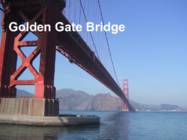
The Golden Gate Bridge, completed after more than four years of construction at a cost of $35 million, opened to traffic on May 28, 1937 at twelve o'clock noon. One of the most interesting Golden Gate Bridge fact is that only eleven workers died during construction, a new safety record for the time. One of the bridge's safety innovations was a net suspended under the floor. This net saved the lives of 19 men during construction . There are also 128 lights installed on the bridge roadway. It makes it beautiful at night-time. The avarage crossings are about 41 million per year, counting both north- and south crossings. The Golden Gate Bridge's paint color is orange vermillion, also called international orange. Architect Irving Morrow selected the color because it blends with the bridge's setting. People say that it is a must see for anyone who visits san francisco and it is the best bridge in America. I would really love to cross that bridge
• History • Construction Golden Gate Bridge connects the city of San Francisco on the northern tip of the San Francisco Peninsula to Marin County as part of US Highway 101 and California State Highway 1 Measures • Total length of Bridge (including approaches): 1.7 miles = 8,981 ft = 2,737 m • Width of Bridge: 90 ft = 27 m • Clearance above water: 220 ft = 67 m • Height of tower above water: 746 ft = 227 m • Height of tower above roadway: 500 ft = 152 m Main reasons of building this bridge • Population centers were growing • Traffic congestion at the ferry docks was becoming intolerable Beginning • The main idea of bridge construction was proposed by Charles Crocker in 1872. • August 27, 1930 Strauss submitted his final plans. • On November 4, 1930, voters within the District went to the polls. 145,697 people supported the bridge construction and 47,005 voted against it.
I would like you to think guess the object im describing. Golden Gate Bridge connects the city of San Francisco on the northern tip of the San Francisco Peninsula to Marin County as part of US Highway 101 and California State Highway 1 • Total length of Bridge (including approaches): 1.7 miles = 8,981 ft = 2,737 m • Width of Bridge: 90 ft = 27 m • Clearance above water: 220 ft = 67 m • Height of tower above water: 746 ft = 227 m • Height of tower above roadway: 500 ft = 152 m Main reason of building this bridge • Population centers were growing • Traffic congestion at the ferry docks was becoming intolerable • The thought of bridge started to develop in 1872 • The main idea of bridge construction was proposed by Charles Crocker, who was a railroad entrepreneur. the idea of a bridge was revived by James Wilkins in 1916 • August 27, 1930 Strauss submitted his final plans. Some speculated that the
suspension, and cantilever bridge building flourished in China while languishing in Europe for nearly eight centuries. Chinese bridge builders experimented with forms and materials, perfecting their techniques. Selected examples, found in the countryside and parks, may be candidates for World Heritage listing. Other fine bridges survive in Iran, such as the Bridge of Khaju at Isfahan (1667), with eighteen pointed arches, carrying an 85ft (26m) wide roadway with walled, shaded passageways, flanked by pavilions and watch towers. This magnificent bridge, combining architecture and engineering in splendid functional harmony, also served as a dam, and included a hostelry where travellers found cool rooms for rest and refreshment after hot desert crossings (Figure 3). Picturesque bridges, such as the Kintaikyo at Iwakuni (1673), with its five wooden arches intricately wedged, slotted, and dovetailed together, are found in Japan
 annaabi.ee