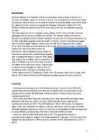
Legislature Riigikogu Kalevipoeg (Kalev's Son) is an epic poem by Friedrich Reinhold Kreutzwald held to be the Estonian national epic. Estonian holidays are mostly based on the Western Christian calendar and Protestant traditions. Notable among these is Jaanipäev, the Estonian Midsummer, which involves seeking one's way to non-urban environments, burning large bonfires, and participating in the drunken revelry of Jaaniõhtu The Estonian Christmas, is generally in line with the Northern and Central European traditions of Christmas trees,Advent calendars, and traditional meals, involving a number of dishes that are typically only eaten on Christmas. Christmas is the most extensive, appreciated, and commercialized holiday in Estonia. Estonian Independence Day is the 24th of February and a national holiday. The Estonian Song Festival is one of the largest amateur choral events in the world.
Predecessors: Theocritus Greek pastoral poet, whose Idylls are set in Arcadia, Virgil, Horace, Spenser, Milton's The Garden of Eden from the Paradise Lost. Influences: 7. G.G. Byron major works: 1806 Hours of Idleness 1809 English Bards and Scotch Reviewers 1813-1818 Childe Harold's Pilgrimage a partly autobiographical narrative poem that describes the travels and reflections of a world-weary young man who, disillusioned with a life of pleasure and revelry, looks for distraction in foreign lands; in a wider sense, it is an expression of the melancholy and disillusionment felt by a generation weary of the wars of the post-Revolutionary and Napoleonic eras. 1813 The Giaour; The Bride of Abydos 1814 The Corsair; Lara 1815 Hebrew melodies 1816 Parisina; The Prisoner of Chillon; The Dream; Prometheus; Darkness 1817 Manfred-a ghost story; The Lament of Tasso 1818 Beppo 1819 Mazeppa; The Prophecy of Dante 1820 Marino Faliero
Due to its history and geography, Estonia's culture has been influenced by the traditions of the adjacent area's various Finnic, Baltic and Germanic peoples as well as the cultural developments in the former dominant powers Sweden and Russia. Estonian holidays are mostly based on the Western Christian calendar and Protestant traditions. Notable among these is Jaanipäev, the Estonian Midsummer which involves seeking one's way to non-urban environments and burning large bonfires and drunken revelry of Jaaniõhtu. The midsummer traditions also include different versions of pairing magic, such as collecting a number of different kinds of flowers and putting them under one's pillow, after which one is meant to see the future spouse in one's dreams. The Estonian Christmas, Jõulud, is generally in line with the North and Middle European traditions of Christmas trees and Advent calendars and traditional meals, involving a number of dishes which are typically only eaten on Christmas. Christmas
which has swallowed a clock in Peter Pan. T h e y are projections o f the Shadow, the unconscious force that threatens to destroy us, sooner or later, if we don't acknowledge it. Further back in our mythic past, Jack's slight, youthful persona resonates with David, the giant-killer, and especially with doomed young gods like Adonis and Balder, who die tragically young. Jack is also a twin with Dionysus, the god o f revelry, passion, intoxication, who appeals to the w i l d side of women, who drives them wild. T h e drunken dance in the lower depths of steerage, in which Rose is drenched head to foot in beer, is a true Dionysian revel and her initiation into those ancient mysteries, with Jack as her initiator. Jack is a H E R O , but of a specialized type, a C A T A L Y S T hero, a W A N D E R E R who is not greatly changed by the story but who triggers change in the other characters
 annaabi.ee