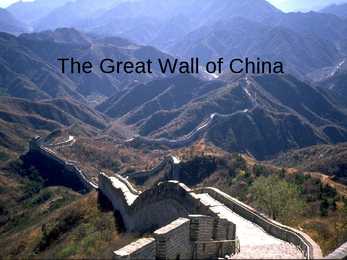
The Great Wall of China Main Facts · approximately 6700 km long · over 2000 years old · up to 16m high, 9.1m wide at base and 3.7m wide at top · average height 10m, witdh 5m History of the Wall · 1st wall in 218-208 BC (3000 miles long) · 4th wall in 1368-1620 · Ming dynasty ruled China · They built thousands of towers and forts · Over 1 million people died Construction of the Wall · made of quarried limestone or granite · in some areas made of fired brick · again over 1 million men died · that's over 300 men per mile · Qin made 70% of population build the wall Importance of the Wall · at first it was ment to keep enemies away, later to keep away semi- nomadic thiefs · nowadays a very popular tourist attraction · Simatai - wall in original state · Beijing reconstructed part · Thousands of tourists every day Parts of the Wall
· The name "Chiltern" comes from the Cilternsæte, a tribe that occupied the area in the early Anglo-Saxon period. · One of the principal Roman settlements in the Roman province of Britannia Superior was sited at Verulamium (now St Albans) and there are significant Roman and Romano-British remains in the area. · Use · The hills have been exploited for their natural resources for millennia. The chalk has been quarried for the manufacture of cement, and flint for local building material. The beechwoods of the Chiltern Hills have for centuries fostered the furniture trade, especially chair making.The clean water from the aquifer is still used for public supply and the chalk of the hills is an important aquifer, exploited to provide water supplies in the area. Protection · The natural beauty of the Chiltern hills is threatened by
smaller pyramids for Khufu's wives, an even smaller "satellite" pyramid and small Mastaba tombs surrounding the pyramid for nobles. There was a town for the workers of Giza, which included a cemetery, bakeries, a beer factory and a copper melting complex Giza's Materials The Great Pyramid consists of more than 2.3 million limestone blocks. The Egyptians got the majority of the limestone blocks from a nearby quarry. The Tufa limestone, used for the casing, was quarried across the river. The largest granite stones in the pyramid, found in the "King's" chamber, weigh up to 80 tonnes and were transported more than 900 kilometers away from Aswan. King's Chamber At the end of the lengthy series of entrance ways leading into the interior is the structure's main chamber, the King's Chamber. The sarcophagus of the King's Chamber was hollowed out of a single piece of Red Aswan granite and has been found to be too large to fit
 annaabi.ee