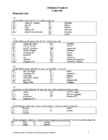
-1 (NO2)-1 nitrite (ClO4)-1 perchlorate (NO3)-1 nitrate (ClO3)-1 chlorate (HSO4)-1 hydrogen sulfate, bisulfate (ClO2)-1 chlorite (HCO3)-1 hydrogen carbonate, bicarbonate (ClO)-1 hypochlorite (HSO3)-1 hydrogen sulfite, bisulfite (IO3)-1 iodate (MnO4)-1 permanganate (BrO3)-1 bromate (OH)-1 hydroxide (C2H3O2)-1 acetate (CN)-1 cyanide (H2PO4)-1 dihydrogen phosphate -2 (SO4)-2 sulfate (CO3)-2 carbonate (CrO4)-2 chromate (SiF6)-2 hexafluorosilicate
Not found in nature. If appears, starts oxidation. In reactions localized at nitrogen or more commonly results in the formation of new C-N bonds. In alkaline solution, azobenzene results, whereas arsenic acid produces the violet-coloring matter violaniline. Chromic acid converts it into quinone, whereas chlorates, in the presence of certain metallic salts (especially of vanadium), give aniline black. Hydrochloric acid and potassium chlorate give chloranil. Potassium permanganate in neutral solution oxidizes it to nitrobenzene, in alkaline solution to azobenzene, ammonia and oxalic acid, in acid solution to aniline black. Hypochlorous acid gives 4-aminophenol and para-amino diphenylamine. Oxidation with persulfate affords a variety of polyanilines compounds. These polymers exhibit rich redox and acid-base properties. 5. Toxicity data on chemical a) General toxicity · Acute toxicity after single administration
The Cataclysmic Death of Stars Republished from the pages of National Geographic magazine Written by Ron Cowen March 2007 Ever since he was a teenager, Stan Woosley has had a love for chemical elements and a fondness for blowing things up. Growing up in the late 1950s in Texas, "I did everything you could do with potassium nitrate, perchlorate, and permanganate, mixed with a lot of other things," he says. "If you mixed potassium nitrate with sulfur and charcoal, you got gunpowder. If you mixed it with sugar, you got a lot of smoke and a nice pink fire." He tested his explosive concoctions on a Fort Worth golf course: "I screwed the jar down tight and ran like hell." "kaboomWoosley", now an astronomer at the University of California at Santa Cruz, has graduated to bigger explosions--much bigger. Woosley studies some of the most powerful
The "printing" seems to be simple photography —probably the best way to make the one accurate copy of the original key that the agent will need; extra evidence for this is that the Russian word gamma ("scale"), which appears to be the Soviet term for one-time pad, is used in photography. Furthermore, the "paper" of the pad is cellulose nitrate, which was used for film in the early days of the motion-picture industry. It is highly inflammable, and spies seem to have kept potassium permanganate at hand to turn an ordinary combustion into an almost explosive reaction to destroy the pads rapidly and completely. No latent image would remain. One-time pads have turned up with a number of top Soviet spies. Rudolf Abel, the highest-ranking Russian agent ever captured in the United States, had the one in the form of a booklet and the size of a postage stamp— 1% X % X % inches. F.B.I, agents found it when they arrested him in his room in New York's Hotel Latham on June 21, 1957
 annaabi.ee