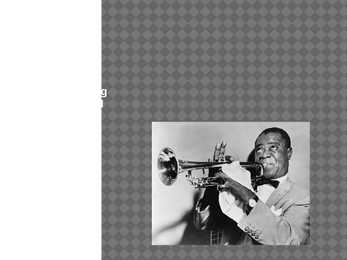
Laul jõudis esimesele kohale Pop Chartis eemaldades Beatle'id positsioonist mida nad olid hoidnud 14 nädalat järjest http://www.youtube.com/watch?v=kmfeKUNDDYs Nõnda kasvas mustanahalisest sajandi alguse tänavapoisist, kes leivapennide teenimiseks mistahes tööd tegi, üles maailma kuningakodade aukülaline ja miljonite poolt kätel kantu, kes ütles: "Ma tahan, et mind mäletataks kui kedagi head, kelle vastu maailm oli hea ja kes seda maailma armastas" Tuntuimad teosed Pala "Muskrat Ramble" (1926) Duett "Big Butter and Egg Man" (1927) "Chinatown, My Chinatown" (1932) "You Can Depend on Me" (1932) "Sweethearts on Parade" "When We Are Dancing" (1952) "Hello, Dolly!"( 1964) "What a Wonderful World" (1968) Aitäh tähelepanu eest!! Katriin ja Ketriin 9.klass
aasta novembris koostööd The Dreamland Syncopators'itega, kus mängis ka ta abikaasa. Sel perioodil "vahetas" ta korneti trompeti vastu. 1919. aasta kevadel läks Louis Armstrong Fate Marable bändi, jäädes sinna 1921. aasta lõpuni. Kontsertidel esines ta aga koos Erskine Tate'i ja Carroll Dickersoni orkestritega. 1929. aasta mais läks Armstrong koos oma orkestriga tagasi New Yorki, kus alustas esinemisi Broadway revüüdes koos orkestriga Hot Chocolates. Tuntuimad teosed: pala "Muskrat Ramble" (1926) duett "Big Butter and Egg Man" (1927) "Hotter than That" "West End Blues" "Ain't Misbehavin" (1929) "Chinatown, My Chinatown" (1932) "You Can Depend on Me" (1932) "All of Me" "Love, You Funny Thing" "Sweethearts on Parade" "Body and Soul" "I'm in the Mood for Love"/"You are My Lucky Star" (1935) "When We Are Dancing" (1952) "Ella and Louis" "Hello, Dolly!"( 1964) "What a Wonderful World" (1968) .... Enamus neist on olnud ka selle aja edetabelites ja pealekauba väga headel
Small islets, however, can really be called bird paradise. Undisturbed by man and protected from most smaller predators by the sea, they are real nesting sanctuaries for a diversity of gulls, terns, ducks and waders. Due to the vast preserved natural landscapes, large raptorial birds, such as the golden eagle and eagle owl have made Estonia their home. Sixty-four species of mammals have been recorded in Estonia, three of them have been introduced: the racoon dog, the American mink and the muskrat. The European beaver, hunted to extinction by 1871, was reintroduced in the 1950s and a vital population of them (17 000) exists once again in Estonia. Another re-introduced species is the red deer (1500). An attempt has been made in Estonia in recent years to disperse the population of wolves, encouraging their spread in areas where their colonies have disappeared, and restricting their numbers in other places where it is too high.
of the East-European Plain, the country has a rather flat surface. The highest and most diverse region in Estonia is in the south-eastern part of the country. At 318 metres, Suur Munamägi is not only the highest point in Estonia, but of all the Baltic countries. There are about 1500 islands in Estonia, the biggest of which being Saaremaa and Hiiumaa. Sixty-four species of mammals have been recorded in Estonia, three of them have been introduced: the racoon dog, the American mink and the muskrat. A couple of species have been re-introduced The European beaver, who was hunted to extinction by the end of the 19th century. A vital population of them now exists in Estonia once again. Another re- introduced species is the red deer. An attempt has been made in Estonia in recent years to disperse the population of wolves, encouraging their spread in areas where their colonies have disappeared, and restricting their numbers in other places where it is too high.
 annaabi.ee