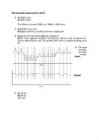
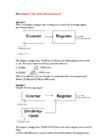
Microcontroller homework for week 07 1. A) 40000 counts B) 36000 counts The difference between 20MHz and 18MHz is 4000 counts. 2. A) 555,555 counts more B) Higher resolution is caused by increased sampling rate. 3. A) Because the mixer needs additional components B) The mixer approach multiplies the frequency shift you want to measure, but also any other frequency shift. This includes drift caused by component heating, noise, etc. 4. The output waveform according
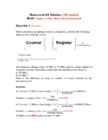
10 MHz 10 MHz =5000 =5555,555 2000 Hz 1800 Hz Between 20MHz and 18MHz are 555,555 counts. b) Explain why this method results in higher resolution. Higher resolution gained by increased sampling rate. Question 3 Consider the following simple mixer circuit. a) Why do we require a low-pass filter when using this mixer circuit? Mixer needs more parts b) Name another disadvantage of such a mixer circuit. The mixer approach multiplies the frequency shift you want to measure, but also any other frequency shift. This includes drift caused by component heating, noise, etc. Question 4 Consider the following circuit and input waveform. Question 3 Draw an equivalent output waveform. Question 3 Question 5 Consider the following LM231 voltage to frequency converter (see LM331.pdf). Assume Rs = 17 kΩ. (Hint: Find the formula to calculate the output frequency fOUT and the values of Rs, RL, Rt, and Ct in LM331.pdf).
a) Why do we require a low-pass filter when using this mixer circuit? b) Name another disadvantage of such a mixer circuit. Solution: a) Because the mixer outputs become four (4) including the two input frequencies, the sum and the difference of them. Actually we need only the difference output frequency (Offset – Input) and the lowpass filter will help to filter aways the higher three output frequencies. b) Name another disadvantage of such a mixer circuit (page 97-98) - The mixer multiplies the wanted frequency shift but also other frequency shifts (origiral, sum, etc.). This includes noises and heating. - If the input frequency comes down and the difference frequency will increases up and may be filtered aways by the low pass filter. - The design of the mixer is complecated. - The circuit may produce more ElectroMagnetic Interference (EMI) Question 4 (10 marks) Consider the following circuit and input waveform. Draw an equivalent output waveform. Solution:
or another. Off-the-shelf mixers are available, such as the Philips NE612. This example used a two-stage L/C low-pass filter. In some applications, you might want to use a more sophisticated filter or a bandpass filter. You could even use a DSP to perform the filtering in software, although that is a significant increase in overall complexity. The mixer approach looks like a simple way to multiply the frequency shift, but it does have some drawbacks: • The mixer approach multiplies the frequency shift you want to measure, but also any other frequency shift. This includes drift caused by component heating, noise, etc. 98 Analog Interfacing to Embedded Microprocessors • The input frequency range has to be limited or it will end up being filtered out. If the 5 MHz input in Figure 4.4 shifted down to 4.5 MHz, the differ- ence frequency would then be 2.5 MHz and would be filtered out by the low-pass filter.
 annaabi.ee