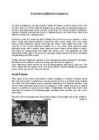
bought during the 18th century. Today Estonian traditional costume is the most spectacularly exposed at "laulupidu", the national song festival, both on the stage and among the audience. Local differences were noticed by the first ethnographers describing Estonians. The main regions fall into South, North, and West Estonia, and the islands as a separate group, reflecting ancient tribal peculiarities. South Estonia This region is the most conservative in dress. Maidens in Southern Estonia bound their hair with a ribbon plaited from colourful pieces of cloth or woollen yarns. Instead of a skirt, the Setu women wore a garment resembling the Russian sarafan. Setu women were extremely fond of silver ornaments: on their chest they wore a conical brooch, in addition to various silver chains. Traditionally, the large setu brooch was only worn by women of child-bearing age; nowadays older women, too, use it as a decoration.
Monticello · Jefferson's design is uncommon · Most of his ambitious plans were never realized Innovation: · Mass production in the early ninetheenth century (cast iron industy) · Popular subjects for spouts: o Fish o rams' and lions' heads o water plants Cast iron malm, valuraud Popular fountain figures before innovation: · Neptune · Nymphs · Maidens · Children · Cherubs · Cupids · Alligators · Serpents · Swans · Cranes · Ducks · dolphins Cherub amorett, maiden neitsi, crane kurg Serpent madu Belmont (Nashville, Tennessee) · Geometric · Decorated with cast iron and Antebellum sõjaeelne, marble marmor, tier rida, kiht marble ornaments · 105-foot-high water tower
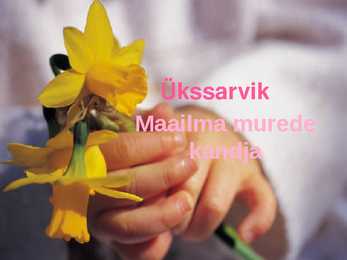
Valge loom kehastab püha andumuse väge Jaht Ükssarvikule Väärtuslik kaup see kuld, mida kannad, Ent väärtusi rohkem on Ükssarve peas; Vaid ühest ta luupäisest sarvekest piisab, Et sööduks ja joobunuks õukond su jääks. L. Ehin Iha, kuulsuse ja au küüsis Leonardo da Vinci kirjutas, kuidas püüda imelooma: the unicorn, through its intemperance and not knowing how to control itself, for the love it bears to fair maidens forgets its ferocity and wildness; and laying aside all fear it will go up to a seated damsel and go to sleep in her lap, and thus the hunters take it Gootika vaibamotiiv eeskuju Aadelkonna kapriis Shakespeare kiitus neile, kes püüavad Ükssarve kinni: wert thou the unicorn, pride and wrath would confound thee and make thine own self the conquest of thy fury Ükssarve skelett loomaaia pargis Ükssarved tänapäeval
THE POOR FARMER'S DAUGHTERS Once upon a time there lived a poor farmer who only had seven children as his treasure. They were all girls, named after every famous queen the country had had. However, none of them was his child they were all orphans, found in the nearby forest many years ago, during the Great War. The eldest one was Margaret; she had long dark shiny hair and big blue eyes. She was a true beauty compared to the other maidens at the village. However, she had a bad side as well the only one she ever cared about was she herself. And when living at the county-side, being an egoist is not good. Lucia was the next. This year she would turn 16 if she hadn't played with a magical potion in the childhood. But, unfortunately, she fell in the kettle filled with liquor of youth and now remains as a 10-year-old for the rest of her life. It's sad, but at least she looks cute with her short blonde hair and cherry-red lips.
was not to the liking of the Estonian audience. The Estonian poetess Anna Haava (1864-1957) reshaped it into poetic form under the title The Daughter of Lembitu 1 Editor’s note: both were popular light romantic pieces rather than challenging pieces demanding the attention of the audience. 2 Exact date unknown. (Lembitu was a 13th-century Estonian leader and freedom fighter against the Livonian Brothers of the Sword). The two-act opera begins with a spring morning scene, maidens are singing, and Aino the daughter of Lembitu appears. A young Estonian Meelis expresses his love for Aino but she declines him, in her aria she appeals to the spirit of her ancestors for strength. In the second act the historical Battle of St. Matthew's Day (September 21st, 1217) has just taken place and Lembitu is dead. Aino, the people, and the knights arrive; the knights demand surrender. Aino is disdainful of both the knights and Meelis, who appeared with them
details and surprises of the individual story. T h e structure should not call attention to itself, nor should it be followed too precisely. T h e order of the stages given here is only one of many possible variations. T h e stages can be deleted, added to, and drastically shuffled without losing any of their power. T h e values of the Hero's Journey are what's important. T h e images of the basic version — young heroes seeking magic swords from old wizards, maidens risking death to save loved ones, knights riding off to fight evil dragons in deep caves, and so on — are just symbols of universal life experiences. T h e symbols can be changed infinitely to suit the story at hand and the needs of the society. T h e Hero's Journey is easily translated to contemporary dramas, comedies, romances, or action-adventures by substituting modern equivalents for the symbolic 19
 annaabi.ee