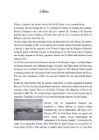
Legend says the Toompea Hill is actually the tumulus mound of the great Kalev. Linda carried rocks to his grave. It is a naturally- formed limestone hill. Lower Town was a merchantile centre, Tallinn also belonged to the Hansaetic League (1285). It is often referred to as the town of citizens. Any grown-up, married and economically independent person, born in a legal marriage between two free people and having lived in the town for at least 3 months, could apply to the Magistracy for citizenship. Serfs could escape from serdom after having successfully hidden in town for a year and a day. Two parts remained separated until the end of the 19th century. Four Names Lyndanise - mentioned by Henricus de Lettis in his Chronicle; derives from the name Linda - the wife of Kalev and mother of Kalevipoeg Koluvan - mentioned in Russian chronicles; derives from the hero Kalev from our national epic
town. The building history of the Town Hall goes back to the 13th century, but it acquired its medieval appearance in 140204. It was as early as 1248 when King Eric IV Ploughpenny of Denmark granted the Lübeck Charter to Tallinn. Relying on that document a town council was elected from amongst merchants of the Hanse and started convening in the Town Hall. It is possible to state on the basis of research findings that a meeting place of the magistracy and a goods depot in the form of a small, fortified town hall, constructed of local limestone, existed in its present location already in the mid-13th century. The town hall first mentioned in a real estate record in 1322 had a large meeting room (consistorium) and, considering the times, a huge warehouse (cellarium civitatis). Three walls and seven windows representing Tallinn's oldest secular architecture have come down to our days from that building.
Medieval Tallinn enjoyed a strategic position at the crossroads of trade between Western and Northern Europe and Russia. The city, with a population of 8,000, was very well fortified with city walls and 66 defence towers. During the Great Northern War the Swedish troops based in Tallinn capitulated to Imperial Russia in 1710, but the local self-government institutions retained their cultural and economical autonomy within Imperial Russia as the Duchy of Estonia. The Magistracy of Reval was abolished in 1889. The 19th century brought industrialization of the city and the port kept its importance. During the last decades of the century Russification measures became stronger. February 1918, the Independence Manifesto was proclaimed in Tallinn, followed by Imperial German occupation and a war of independence with Russia. On 2
 annaabi.ee