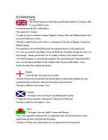
case law, customs and conventions. It contains two main principles the rule of law and the supremacy of Parliament. Parliament is the supreme legislative authority and consists of three separate element: the Sovereign, the House of Lords and the House of Commons. There are 650 Members of Parliament (MPs) each member representing one of the 650 geographical areas (constituencies). The House is presided over by the Speaker. The main function of the House of Commons is to legislate. The House of Lords is presided over by the Lord Chancellor. It is made up of Lords Spiritual and the Lords Temporal, the latter comprise all hereditary and life peers. The leader of the party which obtains a majority of seats in a general election is named Prime Minister. A number of ministers are invited by the Prime Minister to attend regular meetings to discuss policy and this group of ministers is known as the Cabinet. The main opposition party forms a Shadow Cabinet.
founding Treaties, distinguishing between three main types of competence: exclusive competences, shared competences and supporting competences. THE THREE MAIN TYPES OF COMPETENCE The Treaty on the Functioning of the EU (TFEU) distinguishes between three types of competence and draws up a non-exhaustive list of the fields concerned in each case: exclusive competences (Article 3 of the TFEU): the EU alone is able to legislate and adopt binding acts in these fields. The Member States’ role is therefore limited to applying these acts, unless the Union authorises them to adopt certain acts themselves; shared competences (Article 4 of the TFEU): the EU and Member States are authorised to adopt binding acts in these fields. However, Member States may exercise their competence only in so far as the EU has not exercised, or has decided not to exercise, its own competence;
The incident would have been avoidable if he had told the truth. defy v. to show little fear or regard for rules or adv. defyingly established norms; to challenge adj. defying Syn. resist I defy you to find that book in the library's collection. The circus performer demonstrated her death - defying routine. enact v. to pass a law adj. enacted Syn. Legislate n. enactment Congress enacted the legislation during its last session. The enactment of the laws was in the hands of the Senate. even adj. regular, smooth; in equal parts adv. evenly Syn. Equitable n. evenness The sound isn't even turn up the left speaker. The profits were divided evenly among the investors. feign v. to pretend, make believe adj. feigned Syn. simulate
 annaabi.ee