Sally woke up in the morning; she looked at the clock and realized that she has been late to the work. She shook a leg - took a shower, grabbed a sandwich, hopped into her car and drove away. Then she almost ran over a stranger man. She braked the car and blew the horn. Then she realized that it was Michael, a nice handsome guy from the beach party at last weekend. If it's not one thing, it's another. She stooped out of the car window to apologize. She had to hurry but wanted to be nice and polite. She said, "Sorry, Michael I didn't noticed you, are you okay?" "Yes, but I will be better if you'll come out with me tonight, would you?" asked Michael. "Sure!" "Well, then I'll come and pick you up at 7pm!" Then Sally drove away, thinking about what she had done. She promised yesterday to her 10-years old daughter that she will watch a movie with her and now Sally didn't know what to do, her agreeing was just a slip of the tongue. ...
War was the turning point in many areas in life, because after the war new interactive medium have changed the English language more to the American English direction. The object of the work Ø The object of my research work is present day English and understanding that the origin of idioms is closely connected with people's mentality. The subject of the work The subject of my studies is" Idioms in the English language". Idiom is a phrase or expression whose total meaning differs from the meaning of the individual words. Methods of my studies Ø Dictionary of English Idiom; Ø Internet sites; Ø Phraseology of modern English; Ø Communication with English teachers; Ø Reading books and comparing with dictionary; On this subject I studied the literature Ø Antrushina G., Afanasyeva O., Morozova N., Ø Basics of English phraseology by Amosova N., Ø McMarthy, M
Tehiskeelele vastandub loomulik keel. Tehiskeel on keel, mille reeglid on enne kasutamist selgesõnaliselt kehtestatud. Tehiskeelt, mis on loodud eri keelte oskajate vahelist suhtlust kergendava eesmärgiga, nimetatakse abikeeleks. Basic English blaia zimondel blissymbols budinos Earth Language esperanto Folkspraak idiom neutral ido interlingua ehk latino sine flexione interlingue ehk oktsidentaal (occidental) interslaavi keel 3. Kuidas peegeldub keeles kultuur?' Tänu keelele räägitakse oma kultuurist, keel on ise kultuuri osa. 4. Mis on keelemärk ja millest see koosneb? Keelemärk-sõna, koosneb tähenudsest ehk tähistatav, sellega seotud signaalid (tähistaja) 5. Mida tähendab, et keelemärgi tähistava ja tähistaja suhe on meelevaldne
People use idioms to make their language richer and more colorful and to convey subtle shades of meaning or intention or to make a sentence more precise and clean. Runs in the family VS It is common throughout the line of our extended family over a number of generation. Examples: pull smb leg, kick the bucket, Jump the gun - would mean to be doing something early 46. Syntactic freezes (irreversible binomials, trinomials) Irreversible idiom – a multi-word expression whose order cannot be hanged. Also known as freezes Binomial idiom= a two-part irreversible idiom bits and pieces, through thick and thin, spick and span, here and there, safe and sound Trinomial idiom = a three part irrereversible idiom here, there, and everywhere Semantic principles of ordering – me first principle Phonological ordering principles (myopia or the short-long
overthrow the subject. If, in turn, the human form becomes an object, it can considerably liberate possibilities for the modern artist." As he explained in a 1949 essay, by allowing the object to replace the subject, "we were able to consider the human figure as a plastic value, not as a sentimental value. That is why the human figure has remained willfully inexpressive throughout the evolution of my work".[16] As the first painter to take as his idiom the imagery of the machine age, and to make the objects of consumer society the subjects of his paintings, Léger has been called a progenitor of Pop art.[17] He was active as a teacher for many years. Among his pupils were Nadir Afonso, Robert Colescott, Charlotte Gilbertson, Hananiah Harari, Asger Jorn, Beverly Pepper, Victor Reinganum, Marcel Mouly and George L. K. Morris. In 1952, a pair of Léger murals was installed in the General Assembly Hall of the United
voice (and never rather) that drags us in to his steps, although never without drawing up an clear structure, that can reach the exquisite subtlety of “As Bad as to Mile” or “Wires” or sustain architectures cathedrals as in “The Old Fools” or “Dockery and Son”. It is what allows Booth to affirm that “No poet between Byron and Larkin achieves anything like this spontaneously personal ease of idiom, and very few poets aim at it” (1992, 87). To the time that he does not left to observe that “its carefully concealed formal regularity gives it an aesthetic completeness which is sensed rather than consciously heard” (1992, 88). As we have commented before Larkin uses all his ruses to catch the reader, that sensation of long phrase and metric regularity creates a space where the voice takes us to his experience, but without threats in regard on clearness
notion of rights of virtually all its normative significance. Hobbes wishes to say that a man has most rights when he is in the 'state of nature, i.e. a vacuum of law and obligation, since 'in such a condition, every man has a right to everything; even to one another's body'.13 But we could just as well say that in such a condition of things, where nobody has any duty not to take anything he wants, no one has any rights. The fact that we could well say this shows that the ordinary modern idiom of 'rights' does not follow Hobbes all the way to his contrast between law and rights. Nor did Locke or Pufendorf; yet they did adopt his stipulation that 'a right' (jus) is paradigmatically a liberty.14 Their successors are those who today defend the 'choice' theory of rights, which as we saw in the preceding section is one eligible way ofaccounting for most, but not all, of the modern grammar of rights. And even those who defend the
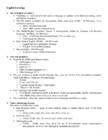
o BUT: his leg was pulled continuously by the other boys Can’t be turned into nouns – gun-jumping Three categories of idioms can be distinguished o Pure – pull sb’s leg, kick the bucket, o Semiliteral – fat chance, take steps, be a stepping stone, jump the gun o Literal – in sum, throw away, according to Elements are not separately modifiable without the loss of the idiomatic meaning. The whole idiom can be modified as a unit. o She pulled her brother’s left leg, she pulled her brother’s leg mercilessly Elements don’t coordinate with genuine semantic constituents o She pulled and twisted her brother’s leg Elements can’t take contrastive stress o It was her brother’s leg that she pulled Elements can’t be referred back to anaphorically o She pulled his brother’s leg, Jon pulled it too
EUGEN KAPP. VII. FURTHER MATURING OF SYMPHONIC MUSIC: HEINO ELLER, EVALD AAV, EDUARD TUBIN. THE FIRST ESTONIAN BALLET. SUMMARY OF THE REPUBLICAN PERIOD. HALF A CENTURY UNDER SOVIET OCCUPATION. IDEOLOGY OVER MUSIC. EXTENSIVE INFLUX OF CONTEMPORARY TRENDS. VIII. THE FORTIES. TRANSFORMATION OF ESTONIAN LIFE. THE WAR-TIME SYMPHONIC OUTPUT. IX. THE PLANTING OF NEW CREATIVE PRINCIPLES DURING THE POST-WAR YEARS. X. THE SECOND HALF OF THE FIFTIES. TOWARDS A MODERN IDIOM: EINO TAMBERG AND VELJO TORMIS. XI. THE NEOCLASSICISM AND CONSTRUCTIVE THINKING OF JAAN RÄÄTS. XII. THE FIRST HALF OF THE SIXTIES. DODECAPHONY OF ARVO PÄRT. XIII. THE DRAMATIC PHILOSOPHICAL OUTPUT OF HELMUT ROSENVALD. XIV. THE ELEMENTS OF JAZZ, FOLK MUSIC AND DODECAPHONY IN THE SYMPHONISM OF ANTI MARGUSTE. XV. HEIMAR ILVES AND HIS MUSIC – DEEP IN THOUGHT AND FEELING. XVI. THE POST-WAR SYMPHONIES OF EDUARD TUBIN. DEEPENING ACCENT ON PSYCHOLOGIC-DRAMATIC EXPRESSION.
We also have corroborating information about the obedience conditions being ones in which the speaker may well have an interest. But at each substage of this reasoning, there is plenty of room for error. At one point Searle suggests that there is a convention at work in addition to the purely Gricean reasoning. The words, "Can you . . . ?" do have a sort of conventional ring. But if so, it cannot be such a brute convention that it makes the locution in question amount to an idiom like "kick the bucket" or "bury the hatchet." Requests beginning with "Can you . . . " are, if you like, idiomatic, but they are not idioms, for they admit of literal answers. The hearer could say, "I can, yes, but are you sure you should be putting any more salt on your food?" This could be a smart-aleck answer ("Do you have the time?"--"Yes, I have it"), but it need not be; perhaps the hearer knows the speaker to have high blood pressure. One is at least able to reply to the
in an unabridged English dictionary. Such a language could, therefore, express the same amount of information as English. But because English prohibits such combinations as "ngwv," it must go beyond the four-letter limit to express its ideas. Thus English is more wasteful, more redundant than this hypothetical four-letter language. The rules that lead to redundancy come from grammar ("I am," not "I is"), phonetics (no word in English may begin with ng), idiom ("believe" alone may not be followed by an infinitive, only by a clause beginning with "that"). Others come from etymology, in which the derivation of a word has left many now-silent letters, as in "through" or "knight." Still others come from limitations on vocabulary. A teen-ager who uses "swell" to mean what an adult might designate by a dozen different terms of approbation utters speech that is much more redundant, more restricted, less variable, less flexible than the adult's
 annaabi.ee