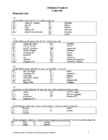
C-4 carbide Polyatomic ions +1 the only commonly encountered ion is the ammonium ion NH4+ ammonium -1 (NO2)-1 nitrite (ClO4)-1 perchlorate (NO3)-1 nitrate (ClO3)-1 chlorate (HSO4)-1 hydrogen sulfate, bisulfate (ClO2)-1 chlorite (HCO3)-1 hydrogen carbonate, bicarbonate (ClO)-1 hypochlorite (HSO3)-1 hydrogen sulfite, bisulfite (IO3)-1 iodate (MnO4)-1 permanganate (BrO3)-1 bromate (OH)-1 hydroxide (C2H3O2)-1 acetate (CN)-1 cyanide (H2PO4)-1 dihydrogen phosphate -2 (SO4)-2 sulfate (CO3)-2 carbonate
variable durations within 12–24 hours, while chilling. the total chilling process lasts 24–48 hours In addition to lactic acid, other chemical (Dickson and Anderson 1991; Hippe et al. agents, such as 0.1 or 0.5% CPC, 0.05–0.1% 1991; Strydom and Buys 1995; Gill and ammonium hydroxide, 0.12% ASC, 0.02% Bryant 1997a; Gill and Jones 1997b; Greer PAA, 0.01% NaOH, or 0.005% sodium and Jones 1997; Stopforth and Sofos 2005; hypochlorite within 48 hours of chilling of Simpson et al. 2006). Spray-chilling has been beef carcass at 3°C to 1°C have been reported adopted in various beef plants because it to reduce inoculated E. coli O157:H7 by 1 to facilitates temperature reductions and reduces 3 log10 CFU/cm2, that is 0.5 to 2 log10 CFU/ losses of carcass surface moisture and weight. cm2 higher than spray-chilling with water Such a process may cause bacterial injury alone (Dickson 1991; Stopforth et al
 annaabi.ee