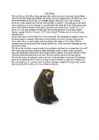
Sun Bear The Sun Bear is 120-150 cm long, making it the smallest member in the bear family. Males tend to be 10-45% larger than females the former normally weigh between 30 and 70 kg , and the latter between 20 and 40 kg. The shoulder height is about 60-72cm .The Sun Bear possesses sickle-shaped claws that are relatively light in weight. It has large paws with naked soles, probably to assist in climbing. Its inward-turned feet make the bear's walk pigeon toed, but it is an excellent climber. It has small, round ears and a stout snout. The tail is 1.2-2.8 inches (3-7 cm) long. Despite its small size, the Sun Bear possesses a very long, slender tongue, ranging from 8 to 10 inches (20-25 cm) in length. The bear uses it to extract honey from beehives. Unlike other bears, the Sun Bear's fur is short and sleek. This adaptation is probably due to the lowland climates it inhabits. Dark black or brown-bl...
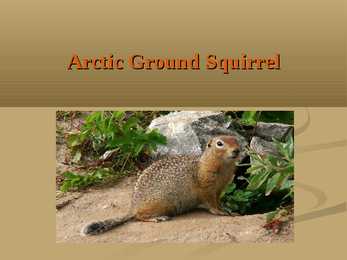
In the summer, it begins to store willow leaves, seeds and grasses in its burrow. Hibernates in the winter (from September to April) and it uses this store of food after it wakes up while it is waiting for spring plants to grow. Sometimes this squirrel carries food back to it's den within its cheeks. Reproduction Arctic ground squirrels mate in May. The female has between five and ten babies. The babies are born blind and hairless in late June. The babies begin to grow hair after about eight days, and their eyes open after about twenty days. The babies will begin to leave the burrow after their eyes open. The babies are fully weaned by September and leave their mother to find or make a burrow of their own. Behaviour Live in colonies of hundreds of squirrels. The colony has couple of dominant males that control the territory.
mammals form the biggest group of animals. Most of the she-marsupials have pouches in which to carry their young. The kangaroo is the best known of all Australian animals. There are many kinds of different kangaroos of different size. They are famous for their hopping style and being the biggest marsupials around. Kangaroos congregate in groups up to ten to feed together. Mother and young stick together for years after the baby has left mama's pouch. They are born as small, bean-sized hairless babies that climb up into the safety of the pouch. After 33 weeks the little kangaroos have to leave the pouch. At top speed kangaroos can make 4m leaps and reach the velocity of 50 km/h. The long, heavy and powerful kangaroo tail makes it all possible by providing balance and stability. Only tree kangaroos can move their hind feet independently of one- another. The wombat is a marsupial rat. The koala or pouched bear lives in the gum- trees
nt TGF-beeta-2 ja TGF-beeta-3, aga mitte TGF-beeta-1, pärsivad kana loote tsiliaarsete ganglionide neuronite elus püsimist, NOTCH - Notch'i aktivatsioon põhjustab tsütoplasmaatilise domeeni (ICD) eemaldamise (proteolüüsi) ja selle migratsiooni tuuma. Tuumas Notchi ICD interaktsioon teiste transkriptsioonifaktoritega aktiveerib Enhancer of Split'i transkriptsiooni. Selle geeni produkt inhibeerib achaete-scute geeni ekspressiooni, mis on vajalik neuroblastide tekkeks. Hairless ja teatud viiruste EBNA2 valk interakteerub Suppressor of Hairless'i promootoriga. Wingless aktiveerib dishevelled'i ja viimane blokeerib Notch geeni aktivatsiooni. Delta/Notch signaalirajad ja Neurogenin1 funktsioneerivad mitmetes eri staadiumites sensoorsete neuronite eristumisel, esmalt neuraalplaadi külgede ja hiljem migreeruva neuraalharja rakkude hulgas. Notch valgud kontrollivad arengulisi valikud ka hemopoeesis, so kas lümfoidsetest progenitoridest saavad B- või T-rakud. Lisaks
Anna notes that the chocolate colour (b at the TYRP1 (B) locus) is not accepted in the Donskoy, although it can be very attractive. For more than seven years, Donskoy Discovery has bred show- quality cats, including some that resembled chocolate colour. Unlike Chocolate Orientals, the Donskoys had an unusual eye colour that appeared pink in some lighting conditions. This was initially attributed to a combination of the chocolate gene with the dominant hairless gene, but the work of Kathryn Eden and Anna Kholmska and genetic testing has shown that the chocolate allele is absent. The cats need to be tested to confirm the presence of the dominant B allele (black). The coat and eye colour could be caused by a novel dilution of black (if B is present) or by some other mutation (if B is absent). All of the cats share a common ancestor. Their genotype (genetic makeup) shows they should be solid black but their phenotype (visual appearance) is chocolate
 annaabi.ee