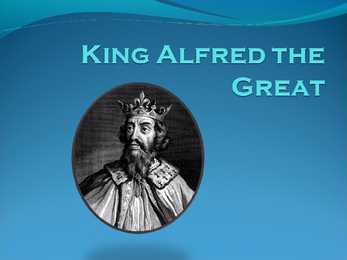
Children: 5 children Died: 899 Buried at: Winchester ·Only King to have epithet"the Great" ·Defended England against Danish invasion and founded the first English navy ·He encouraged the translation of scholarly works from Latin and promoted the development of the Anglo-Saxon Chronicle. ·A new legal code came into force during his reign. ·At the age of 19 in 868 he is recorded as fighting beside his brother in Mercia against the Danes In 878, the Danes under their leader, Guthrum overran Wessex. Alfred and his remnants went into hiding. At Easter time in 879, Alfred set up a base in the region of Athelney. The great Saxon kingdoms of England had been reduced to one man who ruled a small area of swamp. It was from this hidden base in the swamps that King Alfred became Alfred the Great Alfred sent messages to those fighting men that were still loyal to him. Seven weeks after taking refuge at Athelney, Alfred emerged from the swamps with a new army.
They had bad relations with the Romans, which is why they burned down the place. London was rebuilt in the year 100. During the 2nd century, Roman London had a population around 60 000 people. In the 8th century there was a lot of Vikings attacking the city. Alfred the Great, an Anglo-Saxon king, was fighting against them. His people created a new settlement called Lundenwic 2 km upstream of Londinium. In 886 Alfred made peace with the Danish Vikings. Their king was named Guthrum. London Wall The Norman Conquest During the 9th century, London was the largest city of England. At that time, the Duke of Normandy won the Battle of Hastings, which was between England and Normandy. As a result the duke was crowned king of England. His name was William the Conqueror. William granted the citizens of London special privileges. He also built the Tower of London, (which was a prison) to keep the people under control. The Tower is the oldest building used by the British
with the Saxons in southern England and the Angles in the north. The language the Anglo-Saxons spoke (Anglo-Saxon German) gradually developed into Old English. Old English was not a written language. In 787 the Vikings began their invasion from Denmark. They mercilessly raided and pillaged coastal towns in Britain. The king of Wessex, Alfred the Great, resisted and defeated the Vikings in 886. A treaty the Danelaw was signed between King Alfred the Great of Wessex and Guthrum, Danish king of East Anglia. England was divided. Later, the Anglo-Saxon dynasty was restored and lasted until 1066. The last famous Saxon king of England was Edward the Confessor. In 1066 at the battle of Hastings the Norman Duke William defeated the Saxon King Harold and was crowned the king of England. In Norman times three languages were spoken: Latin (by the clergy and the university scholars), Norman-French (by the aristocracy and the king), Anglo- Saxon German (by common people)
Aastaks 871 oli aga jäänud kogu Inglismaal ainukeseks kuningriigiks Wessex. Wessex ja Alfred Suur, 878. a lahing (Edingtonis Wiltshire-s); lepingud Guthrumiga, Danelaw. Alfred Suur – oli Wessexi kuningas. Ainuke kuningas, kes sai liignimeks Suur. Peetakse Inglismaa päästjaks. Kuid ka Wessex hakkas kild-killu haaval minema viikingitele. 878 a – võitis Alfred lahingu viikingitega (Guthrumi vastu). Võit tagas Alfredi kuningaks jäämise. Guthrum nõustus vastu võtma ristiusu, palus Alfredi oma ristiisaks. Lepingud: Viikingitega sõlmiti leping, et Wessex jääb sõltumatuks. East- Anglia jäi viikingitele, Guthrum jäi seal isegi kuningaks. Rahuleping aga ei jäänud jõusse. Alfred kogus kokku suure sõjaväe ja hakkas rajama Londiniumi kohale Londoni asulat. Alfred oli jällegi tugevam ning sõlmiti uus leping (ei teata aastat, u 885-890) – leping on ka säilinud
 annaabi.ee