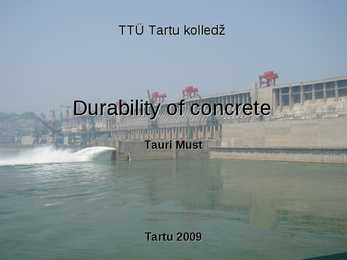
TTÜ Tartu kolledz Durability of concrete Tauri Must Tartu 2009 Main Content Cement Aggregate Sand Water Chemical admixtures Field of application Concrete is used in... · Pavements · architectural structures · Foundations · roads · Bridges · marine- and parking structures · brick/block walls · footings for gates fences Three Georges Dam · The world largest concrete construction · China, river of Yangzte, 2006 · 2,335m long, 101m high Possible threats Physical Chemical · Frost · Sulftates, · Wind · Sea water, · Waves · Acids, · Fire · Alkali-silica reactions Primary transport mechanism through concrete Gas diffusion Water vapour diffusion Water vapour diffusion
First I'll give a brief overview of concrete, we have to know what does it actually means and where is it used? (slide) Basically concrete is a construction material composed of cement, aggregate (generally gravel, limestone, or granite, plus a fine aggregate such as sand) also water, and chemical admixtures.(slide) Concrete is used to make pavements, architectural structures, foundations, roads, bridges, marine- and parking structures, brick/block walls and footings for gates, fences and so forth. Mainly it is used because of its high durability and availability, but also because it is cheaper than to use wood for example. Concrete is used more than any other man-made material in the world.(slide) Moving on, the durability of concrete can be defined as the ability to remain serviceable for at least the required lifetime of the structure of which it forms apart. However there are many
motif, whose horns point heavenward. Because of its placement on the main spire, the horns of moon and finial point combine to create a trident shape, reminiscent of traditional Hindu symbols of Shiva. Construction The Taj Mahal was built on a parcel of land to the south of the walled city of Agra. An area of roughly three acres was excavated, filled with dirt to reduce seepage and leveled at 50 meters above riverbank. In the tomb area, wells were dug and filled with stone and rubble as the footings of the tomb. Instead of lashed bamboo, workmen constructed a colossal brick scaffold that mirrored the tomb. The scaffold was so enormous that foremen estimated it would take years to dismantle. According to the legend, Shah Jahan decreed that anyone could keep the bricks taken from the scaffold, and thus it was dismantled by peasants overnight. A fifteen kilometer tamped-earth ramp was built to transport marble and materials to the construction site
Pont Neuf (1607) in Paris. These bridges, which are among the most famous bridges in the world today, are all on the World Heritage List, although only as components of historic town centre inscriptions. Renaissance engineers had learned much about foundations since Roman times, though they rarely were able to excavate deeply enough to reach hard strata. They had, however, perfected techniques of spread footings - wide timber grillages resting on piles driven into the river bed upon which stone piers were laid. In the foundation of the Rialto Bridge, designer Antonio da Ponte drove six thousand timber piles, capped by three stepped grillages so that the abutment stones could be laid perpendicular to the thrust lines of the arch. Though built on soft alluvial soils, the bridge continues to support a street of jewellery shops enjoyed by tourists four centuries later.
 annaabi.ee