About 30 000 Hectare ground is unusable. We have a large ash mountains thanks to burning of oil shale. To reduce pollution we need to decrease mining of oil shale and shale-based electricity producing. Air pollution the biggest air pollution is in large cities. It´s caused by big factories, a lot cars and deficient environment ordinance. To decrease air pollution we need to use less cars and more public transport. Eutrophication It means water enrichment of nutrient. In eutrophic water there is less oxygen and water quality low. There are some things to improve it: · To disable phosphate use in detergents · Eliminate sources of pollution Example, Estonia eutrophic lakes are Võrtsjärv and Vasula järv. Excessive tree felling Peoples do very often clear cutting and thanks for it animals will lose their place where they live. To decrease this problem we need to do less clear cutting and use less things what is made from wood.
Site of Community Importance (SCI)? April 2004 7.1 List all the habitat types found in Karula National Park according to Natura2000 1. Oligotrophic waters containing very few minerals of sandy plains (Littorelletalia uniflorae) 2. Oligotrophic to mesotrophic standing waters with vegetation of the Littorelletea uniflorae and/or of the Isoeto-Nanojuncetea 3. Hard oligo-mesotrophic waters with benthic vegetation of Chara spp 4. Natural eutrophic lakes with Magnopotamion or Hydrocharition -type vegetation 5. Natural dystrophic lakes and ponds 6. Semi-natural dry grasslands and scrubland facies on calcareous substrates (Festuco-Brometalia) (* important orchid sites) 7. Fennoscandian lowland species-rich dry to mesic grasslands 8. Hydrophilous tall herb fringe communities of plains and of the montane to alpine levels 9. Northern boreal alluvial meadows 10
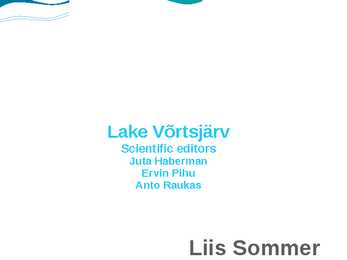
the high waterlevel usually lasts for several months in spring, while even the rise in autumn can be noteable. The mean annual difference in the lake volume between the high and low water level can be threefold. A permanent current system in the lake is lacking. The lake is covered with ice on the average for 135 days a year, from the end of November till the end of April. The average water temperature rises up to 17-21°C in July. Võrtsjärv is a strongly eutrophic lake. The fast expansion of reed thickets and the deterioration of biological diversity are a clear evidence of the eutrophication of the lake during the last decades. However, the high carbonate content of water protects the lake against acid rains. Due to the prevalence of western winds, the reed belt is continuous and lush on the sheltered western shore and broken at the open eastern one. The
TREE 12: 266-269. 51. Tamm, L. 1967. Süstaga Halliste jõel. Eesti Loodus 6: 383-386. 52. Taylor, D. R., Aarssen, L. W. & Loehle, C. 1990. The species-pool hypothesis and plant community diversity. Oikos 68: 371-374. 53. Talvi, T., 2001. Pool-looduslikud kooslused. Ökoloogiliste Tehnoloogiate keskus. 54. Tilman, D. 1982. Resource competition and community structure. Princeton University Press, Princeton. 55. Touzard B., Clément B., Lavorel S. 2002. Successional patterns in an eutrophic alluvial wetland of western France. Wetlands 22 (1): 111-125. 56. Truus L., Tõnisson, A. 1998. The ecology of floodplain grasslands in Estonia. In: Joyce CB, Wade PM (eds) European Wet Grasslands: Biodiversity, Management and Restoration. Wiley, Chichester, 49-60. 57. van der Maarel, E. 1998. Species diversity in plant communities in relation to structure and dynamics. In: During H. J., Werger, M.J.A. & Willems, J. H. (eds.). Diversity and
 annaabi.ee