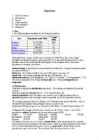
redevelopment of slum areas in the conurbations (such as the Docklands development in London) has been the creation of New Towns such as Harlow in Essex. The industrial area in these purpose-built towns is separate from housing and there are more green, open spaces. New Towns have partially failed, however, especially since many are near enough to conurbations for people to use them as dormitory towns (towns where a large percentage of the population commutes daily to work in a conurbation) and recent government policy has been to expand existing towns like Telford and Milton Keynes (formed from the amalgamation of a group of villages), which is cheaper than creating an entirely new town. 1. Ethnic makeup English 81% Welsh 2% Scottish 10% Northern Irish 2% Irish 2% ethnic minority groups
millennia, London's history goes back to its founding by the Romans. Since its foundation, London has been part of many movements and phenomena throughout history, including the English Renaissance, the Industrial Revolution, and the Gothic Revival. The city's core, the ancient City of London, still retains its limited medieval boundaries; but since at least the 19th century, the name "London" has also referred to the whole metropolis that has developed around it. Today the bulk of this conurbation forms the London region of England and the Greater London administrative area, with its own elected mayor and assembly. London is one of the world's most important business, financial and cultural centres and its influence in politics, education, entertainment, media, fashion and the arts contributes to its status as a major global city. Central London is the headquarters of more than half of the UK's top 100 listed companies (the FTSE 100) and over 100 of Europe's 500 largest companies
two millennia, London's history goes back to its founding by the Romans. Since its foundation, London has been part of many movements and phenomena throughout history, including the English Renaissance, the Industrial Revolution, and the Gothic Revival.The city's core, the ancient City of London, still retains its limited medieval boundaries; but since at least the 19th century, the name "London" has also referred to the whole metropolis that has developed around it. Today the bulk of this conurbation forms the London region of England and the Greater London administrative area, with its own elected mayor and assembly. London is one of the world's most important business, financial and cultural centres and its influence in politics, education, entertainment, media, fashion and the arts contributes to its status as a major global city.Central London is the headquarters of more than half of the UK's top 100 listed companies and over 100 of Europe's 500 largest companies
1%.Samoan is the most widely spoken non-official language (2.3%) followed by French, Hindi, Yue and Northern Chinese.New Zealand has an adult literacy rate of 99%,and 14.2% of the adult population has a bachelor's degree or higher.For 30.4% of the population, some form of secondary qualification is their highest, while 22.4% of New Zealanders have no formal qualification Cities · Auckland - "The City of Sails" - largest and most populated conurbation, with over a million in the metropolitan area, making it the largest in New Zealand by far · Hamilton - 128km south of Auckland, capital of the Waikato, home to the Chiefs (super 14 rugby) and the Magic ( ANZ cup netball). On the banks of the mighty Waikato River. Leafy. · Rotorua - famous for Maori culture, geysers and beautiful hot pools. · Napier - "Art Deco capital of NZ" The city was destroyed by an earthquake in 1931.
the Hebrides. Edinburgh, the country's capital and second largest city, is one of Europe's largest financial centres. It was the hub of the Scottish Enlightenment of the 18th century, which saw Scotland become one of the commercial, intellectual and industrial powerhouses of Europe. Scotland's largest city is Glasgow, which was once one of the world's leading industrial metropolises, and now lies at the centre of the Greater Glasgow conurbation which dominates the Scottish Lowlands. Scottish waters consist of a large sector of the North Atlantic and the North Sea, containing the largest oil reserves in the European Union. The Kingdom of Scotland was an independent state until 1 May 1707 when it joined in a political union with the Kingdom of England to create a united Kingdom of Great Britain. This union was the result of the Treaty
 annaabi.ee