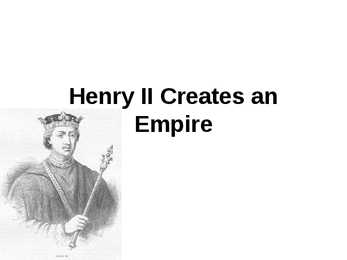
placed him firmly in the ascendancy. · Henry was the most powerful vassal in France. Taking the English Throne · It was 1147 when Henry had accompanied his mother on an invasion of England. · On 22 May 1149 he was knighted by King David I of Scotland. · Within the year he secured his right to the throne. · On 19 December 1154 he was crowned in Westminster Abbey. Lordship over Ireland · Shortly after his coronation, Henry sent a group of clerics to invade Ireland. · In 1171, Henry arrived from France, declaring himself Lord of Ireland. · In 1172, Roman Catholicism was proclaimed as the only permitted religious practice in Ireland. Consolidation in Scotland · An invasion force from Scotland led by their King was advancing from the North. · Flemish armada was sailing for England, just days from landing. · The hostile armada dispersed in the English Channel. · By the end of this crisis the King was "left
Religion The indigenous pre-Christian belief system of the Anglo-Saxons was a form of Germanic paganism and therefore closely related to the Old Norse religion, as well as other Germanic pre-Christian cultures. Christianity gradually replaced the indigenous religion of the Saxons in England around the 7th and 8th centuries. Christianity was introduced into Northumbria and Mercia by monks from Ireland, but the Synod of Whitby settled the choice for Roman Christianity. As the new clerics became the chroniclers, the old religion was partially lost before it was recorded. Despite these prohibitions, numerous elements of the pre-Christian culture of the Anglo-Saxon people survived the Christianisation process. Dress materials Anglo-Saxon clothing usually utilized only three types of fabric. Wool was a coarse material which was used for most garments. Lower class people, such as slaves and poorer peasants could only use wool for their garments, even garments worn against the skin
E.g. the Knight has come back from some war, is high-minded, gentle-humoured and tries to live according to the ideals of courtly love, although he doesn't understand that this code of behaviour is slowly disappearing. The Squire is his young son who has curly hair, is high-spirited and wears a white-sleeved gown embroidered with red flowers who also thinks he is a typical courtly lover. Most of the clerics are ridiculed. E.g. the Monk doesn't pray, he hunts. He is fat, doesn't fast a lot, rides a good horse and is richly dressed. He is still presented in good nature. The Parson is poor but is rich of holy thought and work. The Student rides an extremely lean horse, is poor, dresses threadbare his clothes are shabby because he spends all his money on books. He represents the spirit of learning.
Human love- could be seen as an image of what it meant to love God. The Mother of God, a gracious lady and loving mother could be also worshipped. The cult of Mary emerges and runs parallel with the chivalric idealization of women. For the change of sexual passion into a cult of an idealized woman the warrior had to undergo a cultural transformation. This became possible when he was taken to the king or a great nobleman's court. The courts were run by well-educated clerics who spread the idea of courtier manners and morals. The virtues prized were: no boasting, gentleness, friendliness, moderation, temperate moods. In this times literature and culture of ancient Rome was paid much attention. The works of Virgil, Horace, and Ovid were read, students studied them. Trained in the classics, but in touch with the aspirations and realities of medieval society, the clerks created the chivalric romance of love-new attitude to women
This, after all, was what helped him determine the mechanics of motion. His observations of falling bodies at Pisa are only the most well known of his experiments. He rolled balls of varying size and weight down slopes with varying angles of incline. He showed that an object thrown into the air falls to the earth along a parabola. What he ended up doing was casting doubt on Aristotelian mechanics he challenged the monopoly on scientific education enjoyed by university clerics [ vaimulik ] who had, so he thought, learned nothing since their earliest encounter with Aristotle. Around 1609 Galileo had news of a development from Holland a lens grinder had taken two lenses and placed them at opposite ends of a metal tube. A rudimentary telescope was the result. Galileo made his own telescope as well as a compound microscope. Galileo directed all of his attention to the heavens. He was the
 annaabi.ee