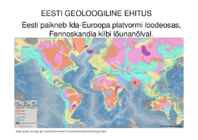
Eesti aluspõhi Mandrite triiv · http://www.ucmp.berkeley.edu/geology/tectoni · http://student.britannica.com/eb/art- 57799/The-changing-Earth-through- geologic-time-from-the-late-Cambrian · http://www.exploratorium.edu/origins/antar ctica/ideas/gondwana2.html · http://www.scotese.com/newpage13.htm Platvorm · Platvorm on suur maakoore osa, mis koosneb kurrutatud kristalsete kivimitega aluskorrast ning seda katvast, kurrutamata kivimitega pealiskorrast. · Pealiskorra pindmist, pudedatest setetest osa nimetatakse pinnakatteks. · Ida-Euroopa platvorm Aluskord · Aluskord on tard- ja moondekivimeist koosnev pealiskorra alune kivimkeha
agriculture important. Farmers grow vegetables and raise cattle. Most important today is the region's white china clay. Most of England is lowland, so these regions have much farmable land and many industriest. In the Midlands a lot of heavy industry is produced. The Wash has country's richest farmland. 7. Characterise the relief in different parts of wales (northern, central, southern) Central part is mostly covered by the Cambrian Mountains, they are especially rugged and beautiful in the north, and they are more rounded in centaral Wales. Southern Wales is largely a plateau deeply cut by river valleys. Best areas for crop farmind, Fertile - viljakas Copper mine - vasekaevandus Poor soil väheviljakas muld tides tõus ja mõõn recreation area - puhkeala china clay - portselanisavi mild climate pehme kliima limestone - paekivi moor nõmm natural resource loodusvara gentle slopes lauged nõlvad
Estonian Academy Publishers, Tallinn. 436 pp. Fig. 159. Isolines of the bedrock topography, drawn after 20 m. Raukas, A., Teedumäe, A. (eds). 1997. Geology and Mineral Resources of Estonia. Estonian Academy Publishers, Tallinn. 436 pp. Fig. 160. Zonation of the bedrock topography (after Tavast 1992): 1 - boundaries of large bedrock forms; 2 - boundaries of medium bedrock forms; 3 - escarpments. I - Depression of the Gulf of Finland: 1 - Sub-Vendian Peneplain; 2 - Cambrian-Vendian Peneplain; 3 - Vendian Escarpment; 4 - Cambrian Escarpment. II - Viru-Harju Plateau: 1 - Ordovician Escarpment; 2 - Pandivere Elevation; 3 - Ahtme Eminence. III - Livonian Lowland: 1 - West-Estonian Lowland; 2 - Depression of the Gulf of Riga. IV - Middle-Devonian Plateau: 1 - South- Sakala Elevation; 2 - Otepää Elevation; 3 - North-Vidzeme Depression. V - Central-Estonian Lowland and Depression of Lake Võrtsjärv. VI - Lake Peipsi Depression. VII - Valga and South-Estonian lowlands
These reactions, among other changes, cause the clay to be converted into a ceramic material. Because of these properties, clay is used for making pottery items, both practical and decorative, and construction products such as bricks, wall and floor tiles. Depending on the content of the soil, clay can appear in various colors, from a dull gray to a deep orange-red. Clay in Estonia (slide 6) There are 3 basic types of clay in Estonia. Firstly from Cambrian era the blue clay, which has blue-greenish color and deposit fields round 100m thick found in North-Estonia. Secondly from Devon era the Red-Brown colored clay mostly find in South-Estonia and finally the layered clay found on islands mainly. The quality of the layerd clay is poor beacause it is limestone-rich. There are aroud 30 filed mineral deposits in Estonia. What is a brick? (slide 7) A brick is a block or a single unit of a ceramic material used in masonry construction.
Many of these sediments have economic significance for it is here that the coal and iron bearing rocks that fuelled Scotland's industrial revolution are to be found. This area has also experienced intense volcanism, Arthur's Seat in Edinburgh being the remnant of a once much larger volcano. This area is relatively low-lying, although even here hills such as the Ochils and Campsie Fells are rarely far from view. comprises ancient rocks from the Cambrian and Precambrian which were uplifted during the later Caledonian Orogeny. It is interspersed with igneous intrusions of a more recent age, the remnants of which have formed mountain massifs such as the Cairngorms and Skye Cuillins. A significant exception to the above are the fossil-bearing beds of Old Red Sandstones found principally along the Moray Firth coast. The Highlands are generally mountainous and the highest elevations in the British Isles are found here. Scotland has over 790
 annaabi.ee