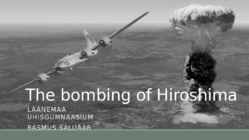
The bombing of Hiroshima L Ä ÄNEMA A ÜHISGÜMNA ASIUM RASMUS SALUÄ ÄR 06.08.1945 · Hiroshima was the primary target of the US on august 6, 1945 · Enola Gay, Artiste and Necessary Evil Why did the americans attack Japan? The attack on Pearl Harbour Hawaii · 4 battleships sunk · 4 battleships damaged · 2 other ships sunk · 3 cruisers damaged · 3 destroyers damaged · 3 other ships damaged · 188 aircrafts destroyed · 159 aircrafts damaged · 2,335 killed · 1,143 wounded Aftermath · Total destruction of Hiroshima · 70 000 killed instantly · Another 70 000 dead by the end of 1945 Little Boy The codename for the atomic bomb · Weight - 4,400 kg · Length - 3.0 m · Diameter - 71 cm
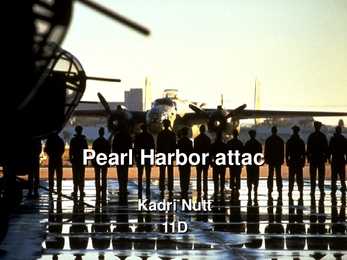
Pearl Harbor attac Kadri Nutt 11D Facts · was a preemptive military strike on the was United States Pacific Fleet base at Pearl Harbor, Hawaii · by the Empire of Japan's Imperial Japanese Navy, on the morning of Sunday, 7 December 1941. · Two attack waves · destroyed two U.S. Navy battleships, one minelayer, two destroyers and 188 aircraft. · Personnel losses were 2,333 killed and 1,139 wounded · Very important fuel storage, shipyards, and submarine facilities were not hit · Japanese losses were minimal at 29 aircraft and five midget submarines, with 65 Japanese servicemen killed or wounded. Reasons · intent was to protect Imperial Japan's advance into Malaya and the Dutch East Indies -- for their natural resources such as oil and rubber --
Railgun usage for spacecraft launces from Earth Source: https://www.nasa.gov/topics/technology/features/horizontallaunch.html 5.2 Military weapons Railguns are being researched as weapons with projectiles that do not contain explosives or propellants, but are given extremely high velocities: 3,500 m/s (approximately Mach 10 at sea level) or more (for comparison, the M16 rifle has a muzzle speed of 930 m/s (3,050 ft/s), and the 16"/50 caliber Mark 7 gun that armed World War II American battleships has a muzzle speed of 760 m/s (2,490 ft/s)), which would make their kinetic energy equal or far superior to the energy 13 yield of an explosive-filled shell of greater mass. This would decrease ammunition size and weight, allowing more ammunition to be carried and eliminating the hazards of carrying explosives or propellants in a tank or naval weapons platform. Also, by firing at greater
In the second half of the century advances in electronics yielded appliances that could be set on times and even programmed, further reducing the domestic workload by allowing washing and cooking to go on without the presence of the human launderer or cook. After the World War II the United States had $26 billion worth of factories that hadn't existed before the war, no bomb damage and practically no competition. All that American companies had to do was stop making tanks and battleships and start making cars and household appliances. By 1950 almost 90% of American families had refrigerators, and nearly three quarters had washing machines, telephones, vacuum cleaners and gas or electric stoves things that most of the rest of the world could still only fantasize about. The 5% of people on Earth who were Americans had more wealth than the other 95% combined. Answer the following questions: 1. Translate the italicized expressions and bold words in the text
secretary. He promptly made himself obnoxious—and drew suspicion upon himself within the consulate staff—by coming to work late or not at all, getting drunk frequently, having women in his quarters overnight, and even insulting the consul himself on occasion. But he managed to tour the islands, and within a month was sending such messages as: "Warships observed at anchor on the llth [of May, 1941] in Pearl Harbor were as follows: Battleships, 11: Colorado, West Virginia, California, Tennessee. . . ." These were sent in the consulate's diplomatic systems, not in naval code. But Mayfield's hopes of peering into these secret activities through the window of a broken code were stymied by the refusal of the cable offices to violate the statute against interception. So when David Sarnoff, president of the Radio Corporation of America, vacationed in Hawaii, Mayfield spoke to him. It was subsequently arranged that thenceforth R.C.A
Suppose I utter a sentence with the intention of performing a certain type of speech act, A. If I violate a strongly constitutive rule, it follows that I have simply failed to perform an act of type A. For example, if tomorrow I utter (3) and break a bottle over the prow of the USS North Carolina, I do not succeed in christening her, for I have not the standing or authority to do so. (The U.S. Navy has explicit rules for appointing the dignitaries who christen 150 Pragmatics and speech acts battleships. There is also the fact that the North Carolina has been christened already, on 12 June 1940.)4 If a clergyman utters (2) to a young couple stand- ing before him in a Chicago chapel, but is not licensed to perform marriages in the state of Illinois, or if one of the couple is not of legally marriageable age, the wedding does not succeed (indeed is not a wedding at all, despite the organ music, rings, and rice). To raise someone five by uttering (6), I have
 annaabi.ee