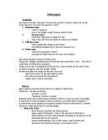
- art partly competes with and imitates nature - animals and plants do things for the sake of an end - plants grow leaves to provide shade for fruit - has roots downwards for nourishment - spiders have a web to catch flies Bacon - argues against Aristotle and his theory of syllogism (deduction) - Deduction: All men are mortal - Socrates is a man - Therefore, Socrates is mortal - deduction from self-evident axioms had led to little or no new scientific knowledge - it only leads to what we already knew or confuses us to make false assumptions - to understand nature properly an empirical method (based on observation) is needed - There are 4 idols (obstacles) to true knowledge 1. Idols of he Tribe: - false illusions caused by the human nature - argues against Protagoras ("man is the measure of all things")
valdkonnad, aksioomid, hierarhiad ja siksakilisuse (zigzagging) järgimine. 40. Kuidas jagunevad valdkonnad aksiomaatilises projekteerimises. Kuidas on erinevad valdkonnad omavahel seotud? Joonistada skeem. Aksiomaatiline disain/projeketeerimine koosneb neljast põhiideest, -etapist: · · valdkonnad (domains) · · hierarhiad (hierarchies) · · sik-sakilisused (zigzagging) · · disaini aksioomid (design axioms) Iga valdkonna sisu on järgmine: Klient- Kliendilt arvamuse/nõu küsimine; Funktsionaalsus- Konstruktsiooni toimimisalased nõuded; Reaalne konstruktsioon- Konstruktsiooni lahenduse parameetrid projekteerimisel; Tootmisprotsess- Tootmisprotsessi tunnused MIS ja KUIDAS. 41. Hierarhia ning siksakilisus aksiomaatilises projekteerimises. Näide Teine peamine idee aksiomaatilise projekteerimise korral on hierarhia kasutamine, mis võimaldab esitada toote disaini/projekteerimise arhitektuuri
) Thus, one will write the clause for "renate" as "`Renate' denotes renates" rather than as "`Renate' denotes cordates." To derive the lat- ter (albeit true) statement from our truth theory, one would need to add the contingent and nonlinguistic premise, "All and only renates are cordates." And, according to Davidson, the meaning of a target sentence is given, not by just the T-sentence directed upon that target sentence, but by the T-sentence together with its derivation from the axioms of the truth theory. To avoid the suggestion that being cordate is part of the meaning of "renate," we can require that the T-sentence's derivation contain no nonlinguistic premises. Second reply "Renate" and "cordate" will be distinguished in sentences containing certain sorts of construction, notably in modal sentences and in belief sentences. Whatever semantics Davidson gives for sentences like "There could be a
 annaabi.ee