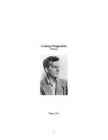
Wittgenstein hoidis ise nendega distantsi. 5 Vahepealne periood Peale "Loogilis-filosoofiline traktaadi" kirjutamist kirjutas Wittgenstein lugematul hulgal käsikirju, koguses umbes 25000 lehekülge. Enamus neist on nüüdseks juba avaldatud. Ainukese artikli, mille ta eluajal avaldas, oli "Remarks on Logical Form", ehk märkused loogilisest vormist. mille ta esitas seltsile Aristotelian Society ettekandmiseks ning see avaldati toimetises. Wittgenstein oli nõrdinud sest tema teoseid polnud keegi eriti avaldanud ja tema mõtteid polnud ükski filosoof omaks võtnud. Wittgensteini varase perioodi ideoloogia ühtib põhiloomult selleagse filosoofia ideestiku ja ootustega ühe universaalse formalismi ning aksiomaatika järele, mille abil saaks kõike kirjeldada. Ludwig Wittgensteinil on elukestev huvi religiooni vastu ning ta väitis, et vaatab
In a previous lecture I suggested that before Isaac Newton could conceive of and demonstrate the laws of universal gravitation, a practical understanding of motion was required. This practical understanding of mechanics would be provided by an Italian astronomer and mathematician by the name of Galileo Galilei. Born at Pisa in 1564, Galileo studied medicine and mathematics and became a professor at Pisa in the late 1580s. But because the largely Aristotelian faculty [ õpetajaskond ] was hostile to him, Galileo decided to move on to Florence. Eventually he settled at Padua and between 1592 and 1610 his mathematics lectures at the university attracted students from across the Continent. The key to all of Galileo's discoveries was the accurate measurement of time. Accurate measurement of time was essential if the mechanics of motion were to be explained. By 1600, there were no accurate clocks or time keeping devices
The movement and phases of the moon. The movement of the planets. There is no reason to think that the Earth is itself a planet. It is difficult to distinguish start and planets with merely naked-eye observation. Unlike stars, planets vary substantially in brightness at times. Stars remain, relative to one another, at fixed positions while planets change positions. Sometimes planets make a backward movement (the retrograde motion). New pieces and new worldview (17C) The old (Aristotelian) worldview (and its variations) dominated from -300 to 1600. (Naked-eye) pieces gave strong evidence for a geocentric worldview of the Universe. Old models favored coherence with the ‘uniform circular motion’ piece of the puzzle. Kepler rejected that piece and designed a model basically similar to our model. His system is simpler than his predecessors and offers accurate descriptions and predictions. However, he failed to explain why planets moved that way.
Dupré, J. (1981) "Natural Kinds and Biological Taxa." Philosophical Review 90: 6690. Elgin, C. and Scheffler, I. (1987) "Mainsprings of Metaphor." Journal of Philosophy 84: 3315. Erwin, E. (1970) The Concept of Meaninglessness. Baltimore, MD: Johns Hopkins University Press. Erwin, E., Kleiman, L., and Zemach, E. (1976) "The Historical Theory of Reference." Australasian Journal of Philosophy 54: 507. Evans, G. (1973) "The Causal Theory of Names." Aristotelian Society Supplementary Volume 47: 187208. ---- (1977) "Pronouns, Quantifiers, and Relative Clauses (I)." Canadian Journal of Philosophy 7: 467536. ---- (1982) The Varieties of Reference. Oxford: Oxford University Press. Evans, G. and McDowell, J. (eds) (1976) Truth and Meaning. Oxford: Oxford University Press. Bibliography 209 Everett, A., and Hofweber, T. (2000) Empty Names, Fiction, and the Puzzles of Non-
If in the past you have accepted the false idea that you cannot make or keep all the money you want, it is now time for you to get rid of that idea. It is a false belief. It is time for you to decide to become financially independent. ■ THE GREAT LAW The Greek philosopher Aristotle first articulated the foundation principle of Western philosophy in about 350 B.C. It became known as the Aristotelian Principle of Causality. Today, we call it the Law of Cause and Effect. This law says that for every effect in your life, there are specific causes. It says that everything happens for a rea- son. Success is not an accident. Failure is not an accident, either. What happens to you is not determined by luck or by coincidence. It is the result of unchanging law.
 annaabi.ee