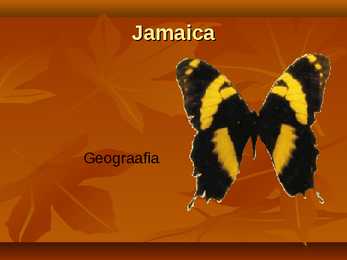
Doctor Bird is a long-tailed hummingbird. The Blue Mahoe (Hibiscus elatus) is the national tree of Jamaica. National Dish Ackee fruit Ackee Flower Ackee oil makes an important contribution to the diet of many Jamaicans. Jamaican dollar The dollar has been the currency of Jamaica since 1969. It is divided into 100 cents. The history Jamaica was inhabited by Arawak Indians when Columbus explored it in 1494 and named it St. Iago. Traditions New Year's Day in Jamaica is a grand celebration time with festive parties and colorful fireworks shows. Famous "Johnkankus" parades and masquerades mark is an age-old New Year tradition of Jamaica. Interests Jamaicans, in general, have a large interest in sports. Cricket, Football (soccer), athletics and horse-racing are several popular sports.
The local climate is tropical and generally hot and humid. The major religions in Guyana are Christianity, Hinduism, Islam and other minor different faiths. Most Guyanese Christians are Protestants and include a mix of all races. Hinduism is dominated by the Indians who came to the country in the early 1800s, while Islam varies between Afro-Guyanese and Indian-Guyanese. When the first Europeans arrived in the area around 1500, Guyana was inhabited by the Arawak and Carib tribes of American Indians. Although Guyana was first sighted by Christopher Columbus during his third voyage in 1498. In 1831 the three separate colonies became a single British colony known as British Guiana. Escaped slaves formed their own settlements known as Maroon communities, but with the abolition of slavery in 1834 many of the former slaves began to settle in urban areas. During the Second World War, the United States arranged for its airforce to use British airports
Jamaica is an island nation of the Greater Antilles, 234 kilometres in length and as much as 80 kilometres in width, amounting to 11, 100 km 2. It is situated in the Caribbean Sea. With 2.8 million people, it is the third most populous anglophone country in North America, after the United States and Canada. Kingston is the largest city in Jamaica and the country's capital. I am interested in this country and it is my favourite country. History The Arawak and Taino indigenous people originating from South America settled on the island between 4000 and 1000 BC. When Christopher Columbus arrived in 1494 there were over 200 villages ruled by caciques. The south coast of Jamaica was the most populated, especially around the area now known as Old Harbour. Christopher Columbus claimed Jamaica for Spain after landing there in 1494. Columbus' probable landing point was Dry Harbour, now called Discovery Bay.
12. There are a lot of Irish people living outside of Ireland. 15 of the US presidents have Irish roots: J.F Kennedy, R. Nixon, R. Reagan, B. Clinton etc. The West Indies 1. The West Indies are situated in the Caribbean Sea, between Caribbean and North Atlantic Ocean, north of South-America. They are known by that name because Columbus thought he had reached India when in fact he had reached the islands. 2. Original inhabitants of the area: Arawak Indians (200 BC) and Carib Indians (AD 1300). 3. For the Europeans, most of these islands were discovered by Columbus during the 15 th century. 4. The area was colonized by England, Spain, France, Portugal and the Netherlands. 5. Languages spoken in The West Indies: English, French, Spanish, also Creole and Pidgin (by black slaves). The origin of the people is mostly African, who were brought there for slavery. 6
The West Indies 1. Where are the West Indies situated? The West Indies is an archipelago around the Carribean Sea. The name is derived from its geographical position and its relation to Columbus' original voyage to the area. 'West' differentiates from the 'Indies' in South and Southeast Asia. 2. Who were the original inhabitants of the area? After 500 BC, the Saladoid people migrated from present-day Venzuela to the Lesser Antilles. Around 650 AD, the Saladoid people were replaced by the Arawak Indians Around 1200 AD, the Arawaks were in turn succeeded by the Caribs. 3. When and by whom were most of these islands discovered for the Europeans? 1490s Christopher Columbus 4. Which countries colonised this area? The Spanish and Portuguese arrived in C16. England, France, and the Netherlands began their conquests in C17. Denmark only acquired a few islands. 5. Which languages are spoken in the West Indies? What is the origin of the people who live there?
Osborne and Roger Toothaker). The witch mania began when two girls, 9 year old Betty Parris and her 11 year old cousin Abigail Williams tried fortune telling. The two were staying with Betty's father, Reverend Samuel Parris. During the winter they and their friends dabbled with fortune telling by cracking eggs into a glass and interpreting the shapes that were formed. The family owned a slave called Tituba. She was an Arawak Indian. (Tituba is often described as a `black slave'. In fact, there is no evidence that she was black. She was actually Native American). She may have been present when the fortune telling took place. It has also been suggested that Tituba told the girls tales about witchcraft and so influenced them. Whatever exactly happened by 20 January 1692 the two girls were having strange fits. A doctor called William Griggs was called but he was unable to explain the fits
significant percentage of them coming from Juárez. El Paso has been among the nation's best economic performers through the recession -- its gains coming, in part, because of Mexico's losses. There has been a positive influx of capital, people and money into El Paso. El Paso's population is 80 percent Hispanic. No one outside really understood this crisis they were living through. *Puerto Rico = *Indigenous people = Taino-Arawak · Boriken Land of the Valiant Lord · Although the Taino Indians are long gone, DNA tests show that more than 60% of Puerto Ricans have a Taino ancestor Nowadays= languages: Spanish, English (both official, although Spanish is the dominant language) · chief of State: President of the US · head of Government: Governor elected for four years monetary unit: US dollar · 80% of Spanish heritage · the rest Afro-Caribbean
 annaabi.ee