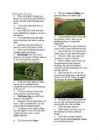
Tundra animals Reindeer Reindeer were first domesticated in Norway and northern Asia. When it was seen how valuable they were, they were brought to Alaska in 1887 and later to parts of Canada. These North American reindeer became known as caribou. Although they are called by different names, they are both considered to be a single species. Unlike deer, both the male and female have antlers. The antlers of the male are long, branched and massive, and they are a little flattened at the ends. The antlers of the female are much shorter, simpler and more slender and irregular. Their large, spreading hooves support the animal in snow in the winter and marshy tundra in the summer. Reindeer are also great swimmers and use their feet as paddles. They can also lower their metabolic rate and go into a semi-hibernation when conditions get very harsh.
*QUAGGA: One of Africa's most famous extinct animals, the quagga was a subspecies of the plain zebra. The quagga was hunted to extinction for meat. The last wild quagga was probably shot in the late 1870s, and the last specimen in captivity died on August 12, 1883 at the Artis Magistra zoo in Amsterdam. *IRISH DEAR: The Irish Elk or Giant Deer, was the largest deer that ever lived. It lived in Eurasia, from Ireland to east of Lake Baikal. The Giant Deer is famous for its size (2.1 meters tall+ antlers 3.65 meters) The cause of theis extinction is still unknown. Some say they died because of their large antlers(could not move in the forest), others say they were hunted down. Extinct about 7,700 years ago *CASPIAN TIGER: The Caspian tiger or Persian tiger was the westernmost subspecies of tiger, found in Iran, Iraq, Afghanistan, Turkey, Mongolia, Kazakhstan, Caucasus, Tajikistan, Turkmenistan and Uzbekistan until it apparently became extinct in the 1970s. Of all the tigers
The Money song Try to find a fool, who's not afraid of a monster If the monster's taste of money in his mouth Money plays the leading role in life ( yes it does ) Money it´s happiness and love High thoughts that´s clear rubbish There's no life without money Eat and sleep, scratch your antlers That´s all you want from your life The vis of money is big and eternal Life is short, cash is long Who has a bit or a little They won't have a nice, they won't have a nice They won't have a nice future
Most widely distributed. Cubs birth. Extremely fast. Range in colours. Cubs can climb. Male bear's heavier. Poor eyesight. Black bear. Seen in different shades. Shy, easy to frighten, curious. Good climbers and swimmers. Live over 25 years. Good hearing, sense of smell. Polar bear. Only humans prey or hunt. Fur is not white. Tend to overheat more. Can swim up to 100 miles (161 km). Cubs learn to freeze. Caribou. Covered with winter coat. Wear antlers. Releases special scent when faced with danger. Live about 4,5 years. Very fast. Moose. Largest members of the deer family. Good sense of smell and hearing. Lives about 1525 years. "Twig eater." Can run up to 56 km. Very good swimmers. Mountain goat. Goatantelopes. Thick white fur (double coat). In spring they rub their body against the rocks. Offers various sounds. Lives about 1215 years. Bison. Largest North America's land animals. Predators: human and wolves.
formed by meltic ice(around 6000 BC), ramparts. Britain was part of the European land mass. · The earliest inhabitants lived in limestone caves. · About 3000 BC the British Isles were inhabited by a people as known as the Iberians. · Celts and Iberians both lived under · They used stone axes and made the primitive system: there was no antlers and bones into leather-working private property, no classes and tools. exploitation. · Inhabitants put up buildings of · They caught fish, grew wheat and stone and wood, built the first roads. corn as well as tamed and bred animals. · There can be find Neolithic burial
wide, 2.5 ft thick Class Question How much do you think the vertical sarsens weigh?? Answer 26 45 tons each Origin of the stones Great debate. Were they moved to the area or left by a glacier?? Half of the stones were probably moved 200 miles by water and land from Wales Half of the stones were probably from 24 miles away A phenomenal feat to move them!! How were the stones moved? Great debate by historians and archeologists Primitive tools made from deer antlers or stones were used to pry the stone out of the ground Long poles were used as levers to lift the stone onto a sledge Ropes of hide were used to drag the stones Question How many people do you think it took to move a sarsen? How long do you think it took to move all of the sarsens? Answer 1000 men to haul one 45 ton sarsen 10 years to move all of the sarsens How were they shaped? Stone axes Stone and wood wedges, flames and cold water to crack the stone
There are many interesting animals. Badger is one of them. It belongs to the weasel family. It is one of the biggest in that carnivore family. Good paintbrushes are made from its fur. They eat snakes, squirrels and insects. Snake poison doesn't harm these mammals unless the snake strikes its nose. Moose live also in Canada. They live in marshy areas all around the country. They are reddish brown and the males are bigger than the females. Moose are herbivores. The male moose have big antlers, female ones don't have them. Prairie dogs are very funny-looking animals. They are rodents who live in tunnels under the ground. They are very good diggers. Prairie dogs are 30 centimetres long. They eat insects and grass. Land. Canada is divided into five major regions geographically: the Pacific Region, the Prairie Provinces, Central Canada, the Atlantic Provinces and the North. The Pacific Region includes British Columbia. The region is known for its
* the flag is called the Saint Patrick's Cross 2) History Prehistoric Britain, Roman Britain, Anglo-Saxon, Danish, Norman invasions (...-1066): Britain was part of the European land mass until the end of the last Ice Age. It became an island by about 6000 BC. From about 3000 to 2000 BC the British Isles were inhabited by a group of people called the Iberians. These Stone Age people lived in limestone caves, they used stone axes and fashioned antlers and bones into leather-working tools. Later groups of people from what are now Germany, the Netherlands and Brittany also settled in Briton. During the Bronze Age, they mined tin, gold and copper and made bronze tools. They also probably built the spectacular prehistoric megaliths, such as Stonehenge on Salisbury Plain. The Celts invaded the British Isles in the 5th century BC in two waves. The Britons grew wheat and corn, caught fish, and tamed and bred animals
 annaabi.ee