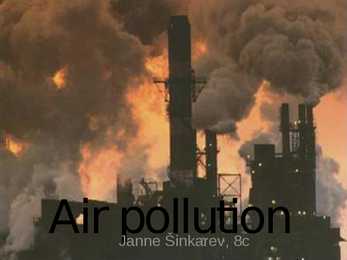
Air pollution Janne Sinkarev, 8c Air pollution · Natural sources such as: Dust,smoke, volcanic eruption and · What is it? also forest fire. · Air pollution is the introduction of · Anthropogenic sources such as: chemicals, particulate matter, or aerosol sprays, toxic biological materials that cause gases,rocketry and some more for harm or discomfort to humans or millitary use. Also chemicals and other living organisms, or dust. Also transport: cars, motor damages the natural environment vehickles, marine vessels, planes. into the atmosphere. · Air pollution divided into two: Air
temperatures averaged across the region. 14.The last time the polar regions were significantly warmer than present was about 125,000 years ago. 15.The sea level was probably 4 to 6 m higher during the last interglacial period. 16.It would change at a rate of about 0.1°C per decade. 17.During 1990-2005 the global temperature has increased between 0.15 °C and 0.3 °C per decade. 18.If greenhouse gas concentrations were stabilized, anthropogenic warming and sea level rise would continue for centuries.
/Toim. H. Palang, H. Sooväli. Tartu Ülikooli geograafia instituut väljaanne nr 91. Tartu: Tartu Ülikooli Kirjastuse trükikoda, lk 1821. • Palang, H. (2001).Maastikest siin raamatus– Maastik: loodus ja kultuur. Maastiku käsitlusi Eestis. /Toim. H. Palang, H. Sooväli. Tartu Ülikooli geograafia instituut väljaanne nr 91. Tartu: Tartu Ülikooli Kirjastuse trükikoda, lk 8-10. • Zhang, Y. (2016). Landscape pattern and transition under natural and anthropogenic disturbance in an arid region of northwestern China.- International Journal of Applied Earth Observation and Geoinformation. Väljaanne nr. 44. lk 1-10 • Vaz, E. (2016). The future of landscapes and habitats: The regional science contribution to the understanding of geographical space.- Habitat International. Väljaanne nr. 51. lk 70-78
responsible for the widespread occurrence of savanna in tropical Australia and New Guinea and savannas in India are a creation of human fire use. The maquis shrub savannas of the Mediterranean region were likewise created and maintained by anthropogenic fire. These fires are usually confined to the herbaceous layer and do little long term damage to mature trees. However, these fires do serve to either kill or suppress tree seedlings, thus preventing the establishment of a continuous tree canopy which would prevent further grass growth. Prior to European settlement aboriginal land use practices, including fire, influenced vegetation and may have maintained and modified savanna flora. It has been suggested by many
humus found in soil, sediment, or aquatic environments. The process by which humic acid forms in humus is not well understood, but the consensus is that it accumulates gradually as a residue from the metabolism of microorganisms. Transition and heavy metals--for example, Fe3+ or Pb2+--as well as other compounds having aromatic or hydrophobic (water-insoluble) chemical structures (i.e., organic pesticides or anthropogenic hydrocarbons), react strongly with humic acid. This property makes it an effective agent in sequestering many of the pollutants in terrestrial and aquatic environments. Fulvohape Väiksema molekulmassiga kui humiinhape. This organic matter is soluble in strong acid (pH = 1) and has the average chemical formula C135H182O95N5S2. One of two classes of natural acidic organic polymer that can be extracted
Geological Record. http://www.smu.ca/academic/science/geology/bios/documen ts/ALARMISTGLOBALWARMINGMODELSVSTHEGE OLOGICALRECORDHongKong2007.pdf Kallaste, T. 2001. Eesti kui ÜRO kliimamuutuste raamkonventsiooni liikmesriik. SEI. Tallinn. Labitzke, K. 1987. Sunspots, the QBO, and the stratospheric temperature in the North Polar region. Geophysical Research Letters, 14, 535. McKitrick, R.R., Michaels, P.J. 2007. Quantifying the influence of anthropogenic surface processes and inhomogeneities on gridded global climate data. - J. Geophys. Res., 112. http://www.uoguelph.ca/~rmckitri/research/jgr07/M&M.JG RDec07.pdf Murdmaa, I. 2004. Kliima soojenemises on süüdi päike ja ookean. - Horisont, nr 5. http://www.loodusajakiri.ee/horisont/artikkel341_326.html Nestor, H., Raukas, A., Veskimäe, R. 2004. Maa Universumis. Möödanik, tänapäev, tulevik. Tallinn. Raukas, A. 2006. Kliima ja teadusmüüdid meie ümber. -
 annaabi.ee