In other words, perceptions starts with light reflected by objects which creates an optic array containing all the visual information from the environment to the eye as a stationary perceiver. Although motion changes some aspects in optic array, however, it provides unambiguous and invariant information about the layout and objects in space. He differs in this information in three forms: optic flow patterns (motion and stereopsis), texture gradient and affordances. Optic flow patterns generally refer to the changes in optic array as the perceiver moves about. Texture gradients (or gradients of texture density) are important depth cues perceived directly without the need for any inferences, as this high-order pattern or structure acts as a source of information about our environment. Affordances are directly perceivable potential uses or objects, and are closely linked with ecological optics
developed parks. · They are aware of differences in experience between such valued `places' and other `spaces'. They choose the places because these places offer some key environmental attributes--spatial, physical, and social--that support behaviors that children want to engage in. · Due to these attributes, behaviors in places are different from behaviors in other spaces, with the former being more purposive, social, creative, and dependent on particular affordances of the setting. · This observational analysis showed that settings children mention to be important to them are utilized more often (about twice as much) than their counterparts, showing a variety of behaviors, incorporating more intentional activities (as opposed to transient, short-lived ones), encouraging group behaviors (as opposed to single-person activities), and providing children with a sense of their own territorial play area.
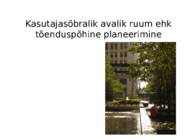
· Taju-uuringud enamasti kognitiivpsühholoogia(uurib vaimse tegevuse protsesse ja struktuuri. Eeldatakse, et ajus on füüsilised struktuurid, mis määravad aju tegevuse ) suund, tuleb arvestda veel ühte vägagi mõjukat suundumust, mille koondnimeks on ökoloogiline lähenemisnurk tajule ja toimingutele. Selle suuna rajajaks oli James J. Gibson. Tajus on esindatud eelkõige keskkonna (metsa, põllu, tänava, kabineti jmt) nn võimalused (affordances )- see, mida üks või teine objekt, ese, selle omadus võimaldavad teha, kuidas neid saab kasutada, mida neilt oodata. · Võites kiiruses, võrreldavuses ja universaalsuses, kaotame paraku nüansirikkuses, täpsuses ja riskime olla eelarvamuslik või ebaobjektiivne. Inimese tajus on oluline koht täita ka kindlatel üksikomadustel ja tunnustel nagu näol, zestidel, kõnnakul, kõnel, kehaehitusel, aga ka välistel tunnustel nagu kosmeetika, riietus jne.
 annaabi.ee