Gustav II Adolf Margaret Põldsaar Gustavus Adolphus 1594-1632 Kuningas 1611-1632 Vasa dünastia Luterlus Halvad omadused - tormakus, avar mõttelend 2 Perekond Maria Eleonora von Bradenburg - 1620 Lapsed Kristina Augusta Kristiina I 3 Troonile saamine Charles IX 16 - aastane Sõdade lõpetamine 1613 - rahu Taaniga 1617 - sõja lõpp Venemaaga 1629 - rahu Poolaga 4 Kolmekümneaastane sõda 1618 - 1648 Hiilgav väejuht Territoorium laieneb Edukas armee Läänemere võimsaim riik Napoleon austas 5 6 Lützelni lahing - surm 6. november 1632 Suri haavadesse Nyköpingi loss Lahingu võitsid rootslased 7 Tähtsus Eestile Tähelepanu haridusele Gustav Adolfi Gümnaasium - 1631 Academia Dorpatensis - Tartu Ülikool - 1632 Asustamisürik ...
There`s about 103,284 peoples live in Tartu. Area of Tartu is about 38.8 km2. Mayor of Tartu is Urmas Kruuse. There`s 80% estonians, 15% russians and 5% other nationals live in Tartu. The city is best known for being home to the University of Tartu. It was founded in 1632 by the king of SwedenGustavus Adolphus. Kallaste caves · Kallaste caves greatest height is 8 meters. · They are located in Devonian sandstone, which is the Estonian longest sandstone. "Kissing Students" "Kissing students" is a sculpture located in Tartu Town Hall Square. The statue architect was Tiit Trummal. The designer of statue was Mati Karmini.
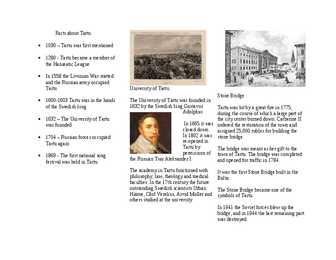
· In 1558 the Livonian War started and the Russian army occupied Tartu University of Tartu Stone Bridge · 1600-1603 Tartu was in the hands The University of Tartu was founded in of the Swedish king 1632 by the Swedish king Gustavus Tartu was hit by a great fire in 1775, Adolphus. during the course of which a large part of · 1632 The University of Tartu the city center burned down. Catherine II was founded In 1665 it was ordered the restoration of the town and closed down. assigned 25,000 rubles for building the
Tallinn is a European Capital of Culture for 2011, along with Turku, Finland. Tartu is the second largest city of Estonia. Tartu in an area of 38.8 square kilometers In contrast to Estonia's political and financial capital Tallinn, Tartu is often considered the intellectual and cultural hub, especially since it is home to Estonia's oldest and most renowned university. The city is best known for being home to the University of Tartu, founded under King Gustavus Adolphus of Sweden in 1632. The university is one of the largest employers, which explains the large proportion of highly skilled professionals researchers, professors, doctors. The solgan of Tartu is "The City of Good Thougths" Situated 186 km southeast of Tallinn, the city is the centre of southern Estonia. The river Emajõgi, which connects the two largest lakes of Estonia, crosses Tartu. There are 17 neighbourhoods in Tartu. The city is served by Tartu Airport. The first written records of
with service to Helsinki, and a small port for Linda Line catamarans. University of Tartu The University of Tartu (Estonian: Tartu Ülikool, Latin: Universitas Tartuensis) is a classical university in the city of Tartu, Estonia. University of Tartu is the national university of Estonia; it is the biggest and highest-ranked university in Estonia. The University of Tartu is a member of the Coimbra Group and the Utrecht Network, and was established by King Gustavus Adolphus of Sweden in 1632, thus being one of the oldest universities in Northern Europe. The university's four museums, its Botanical Gardens, and sports facilities are, by and large, open to the general public. The University possesses some 150 buildings, 30 of which are outside of Tartu. 31 of its buildings decorate the city as architectural monuments. However, the current reforms include attempts to sell, or have the state co-sponsor, several of these
*Estonians conquered by the crusaders 1208 *Reformation 16th century establishments of new school, Estonians first book appeared in 1525 *Tartu University 1632 founded by King Gustavus II Adolphus, classical university, member of the Coimbra group *Abolition of serfdom 1816 *Song festival 1869 in Tartu, an organiser was J.V.Jannsen, 822 singers, men only *Declaration of independence 24th February 1918 *War of independence 1918-1920 during the Russian Civil War, resulted in a victory for Estonia *Deportation 1949 *Estonia becomes independent 20th August 1991 *Joining EU 1st May 2004
7 Kasutatud kirjandus 1. Gustav II Adolf Narvas ja Tallinnas. http://www.histrodamus.ee/? event=Show_event&event_id=3081&layer=192&lang=est#3076 2. Gustav II Adolf taas Narvas. http://www.histrodamus.ee/? event=Show_event&event_id=3081&layer=192&lang=est#3080 3. Gustav II Adolf viimast korda Tallinnas. http://www.histrodamus.ee/? event=Show_event&event_id=3081&layer=192&lang=est#3081 4. Gustavus Adolphus of Sweden. http://en.wikipedia.org/wiki/Gustavus_Adolphus_of_Sweden 5. Rootsi aeg. http://www.miksike.ee/docs/referaadid2007/rootsi_aeg_mari-liismererand.htm 6. Rootsi aeg Eestis. http://www.histrodamus.ee/? event=Show_event&event_id=3355&layer=146&lang=est#3355 7. Tartu Ülikooli lugu. http://webcache.googleusercontent.com/search? q=cache:dPMBqrPyDdMJ:www.ut.ee/et/tartu-ulikooli- lugu+&cd=6&hl=et&ct=clnk&gl=ee 8. Tähtsamad sündmused ajaloost ja ajalookäik. http://kuusemets.planet
Modern Estonian popular music has received attention also in foreign countries, especially on the rock and metal scenes, with such bands as Vanilla Ninja, Metsatöll and Arvo Pärt gaining international acclaim. Cinema in Estonia started in 1908. The first regular radio broadcasts in Estonia began in 1926. Estonian Television (ETV) is the national public television station of Estonia. Its first broadcast was on July 19, 1955. The University of Tartu was established by King Gustavus Adolphus of Sweden in 1632. Bengt Gottfried Forselius was a founder of public education in Estonia and author of the first Estonian language ABC-book, and creator of a spelling system which made the teaching and learning of Estonian easier. The most typical foods in Estonia are black bread, pork, potatoes and milk-related products. Estonians themselves have considered blood sausage (verivorst) and sauerkraut (hapukapsas) "typical Estonian foods", but mostly those are eaten only at Christmas.
konstruktiivne teooria õiguse ja eetika suhetest, mis püüab vältida nii õiguspositivismi kui ka loomuõiguse vigu. Keskmise põlvkonna tuntumaid õigusfilosoofe Ronald Dworkin on üks peamiseid selle suuna tähistajaid, mille eesmärk on positivistliku analüütik täiendamine loomuõiguse elementidega. Nimelt loomuõiguslased on püüdnud lähtuda sellest, mille jaoks õigus üldse olemas on. Seetõttu aga ongi nad vaadelnud õiguse ja eetika vahekorda selle ideaalis. Herbert Lionel Adolphus Hart positsioon tänapäevases õigusfilosoofias on omamoodi kompromislik. Ühelt poolt positivisti ja analüütikuna, Hart oli enne õigusteadusesse siirdumist filosoofiaõppejõud ja pidas loenguid analüütilise filosoofia alal ka USA-s, on ta tuntud mees positivistide leeris. Teiselt poolt aga Benthami ja Austini reformijana ja vana positivismi kriitika hea tundjana on ta populaarne ka positivismi vastaste seas
Varsti jõudsime ühe meeldiva süütu näoga noore maamehe juurde, kes istus puutüvel ja pühkis higi näolt, sest ilm oli kangesti soe. Ta kõrval oli kaks suurt käsitaskut. 368 «Sõida kaldale!» käskis kuningas. Tegin seda. «Kuhu te sooviksite minna, noormees?» «Aurikule, et Orleansi sõita.» «Tulge paati,» ütles kuningas, «kannatage üks silmapilk, mu teener aitab teil reisikotte kända. Hüppa välja ja aita härrat, Adolphus,» sellega mõtles ta mind, nagu nägin. Tegin, mis ta käskis, siis sõitsime kolmekesi minema. Noormees oli kangesti tänulik, rääkis, et oli kibe sihukese ilmaga pakke maad mööda tassida. Ta küsis kuningalt, kuhu ta sõitis; kuningas seletas, ta olevat jõgepidi alla tulnud ja hommikul teises linnas maabunud; nüüd minevat ta mõni miil edasi, et seal teisel pool üht sõpra ta farmis külastada. Noormees ütles:
 annaabi.ee