History of Estonia Elina, Rasmus, Joosep Pre-history The Mesolithic Period The Neolithic Period The Bronze Age The Iron Age Early Middle Ages Click to edit Master text styles Second level Third level Fourth level Fifth level Counties of Ancient Estonia The Middle Ages Danish Estonia Swedish Coastal Settlements Terra Mariana The Reformation Period Division of Estonia in the Livonian War PolishLithuanian Commonwealth Estonia in the Swedish Empire Estonia in the Russian Empire Age of Enlightenment National Awakening Road to Republic Occupation of Estonia by German Empire. United Baltic Duchy Declaration of Independance As a result of the availability of education Age of awakening Red Army's retreat and arrival of German troops in Pärnu on 23 February in Tallinn on 24 February 1918 Independence (1918-1939) Tartu peace treaty in 1920 First recognized by Finl...
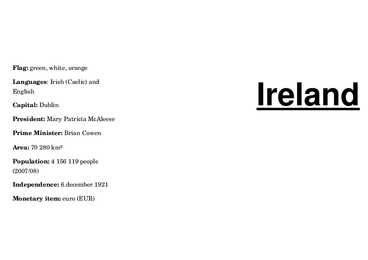
Flag: green, white, orange Ireland Languages: Irish (Caelic) and English Capital: Dublin President: Mary Patricia McAleese Prime Minister: Brian Cowen Area: 70 280 km² Population: 4 156 119 people (2007/08) Independence: 6.december 1921 Monetary item: euro (EUR) Ireland is the second biggest island in Sights: Malahid Castle; Howth the Drink: Irish coffee is one of the best the Europe. It is washed and ritch peole live there; rocks; sea; coffees in the world. influenced by the Atlantic Ocean in Temple Bar for tourists only; Trinity the west and the Irish Sea in the College it has very old library. east. Sport: Ireland's national sports ...
Irish History Tallinn 2009 Ireland is the third-largest island in Europe, and the twentieth-largest island in the world. It lies to the north-west of continental Europe and is surrounded by hundreds of islands and islets. To the east of Ireland, separated by the Irish Sea, is the island of Great Britain. Politically, the state Ireland (described as the Republic of Ireland) covers five-sixths of the island, with Northern Ireland, part of the United Kingdom, covering the remainder in the north-east. The first settlements in Ireland date from 8000 BC. By 200 BC Celtic migration and influence had come to dominate the island. Relatively small scale settlement by both the Vikings and Normans in the Middle Ages gave way to complete English domination by the 1600s. Protestant English rule resulted in the marginalisation of the Catholic majority, although in the north-east, Protestants were in the majority. A famine in the mid-1800s...
A single nation. A million voices. The fall of and empire. Main events in Estonian history NIMI Ancient Estonia · Begins from around 8500 BC. · Worshipped the spirits of nature. · Own gods. · 5 periods: mesolithic, neolithic, bronze age, iron age, early middle ages. Click icon to add picture Click icon to add picture Estonian crusade · One of the last corners of medieval Europe to be christianized. · Against pagans in Estonia. ...
Stonehenge Stonehenge is a prehistoric monument located in the English county of Wiltshire, about 3.2 kilometres (2.0 mi) west of Amesbury and 13 kilometres (8.1 mi) north of Salisbury. One of the most famous prehistoric sites in the world, Stonehenge is composed of earthworks surrounding a circular setting of large standing stones. Archaeologists had believed that the iconic stone monument was erected around 2500 BC, as described in the chronology below. However one recent theory has suggested that the first stones were not erected until 2400-2200 BC,[1] whilst another suggests that bluestones may have been erected at the site as early as 3000 BC (see phase 1 below). The surrounding circular earth bank and ditch, which constitute the earliest phase of the monument, have been dated to about 3100 BC. The site and its surroundings were added to the UNESCO's list of World Heritage Sites in 1986 in a co-lis...
The foundation stones The Island Britain has a mild climate due to the Gulf Stream which brings warm waters from the Gulf of Mexico. The northern part of the island in average 5'C cooler and it's mountainous or hilly and that's why the south has been more populated.. Britain became an island only 5000 years BC after the Ice Age ended. Britain's prehistory The first evidence of human life on the island are dated back to 250 000 BC. 50 000 BC in a milder Ice Age period Britain became habitable again. People from that time were the ancestors of the modern British. 10 000 BC ige age ended and Britain became inhabited by small groups of hunters who probably followed herds of deer. 5000BC Britain became an island and deer died out. 3000BC the Neolithic people came (probably from Spanish peninsula or even North African ...
Report of SCOTLAND Maiki Joakit 10. klass 2008 Etymology Scotland is from the Latin Scoti, the term applied to Gaels. The Late Latin word Scotia (land of the Gaels) was initially used to refer to Ireland. By the 11th century at the latest, Scotia was being used to refer to (Gaelic-speaking) Scotland north of the river Forth, alongside Albania or Albany, both derived from the Gaelic Alba. The use of the words Scots and Scotland to encompass all of what is now Scotland became common in the Late Middle Ages. History Repeated glaciations, which covered the entire land-mass of modern Scotland, have destroyed any traces of human habitation that may have existed before the Mesolithic period. It is believed that the first post-glacial groups of hunter-gatherers arrived in Scotland around 12,800 years ago, as the ice sheet retreated after the last glaciation. Groups of settlers began building the first known permanen...
I. Portugal ABOUT Photo Location of Portugal (dark green) Portugal (Portuguese: Portugal, IPA: [putua]; officially the Portuguese Republic, Portuguese: República Portuguesa) is a country located in Southwestern Europe, on the Iberian Peninsula. It is the westernmost country of mainland Europe, and is bordered by the Atlantic Ocean to the west and south and by Spain to the north and east. The Atlantic archipelagos of the Azores and Madeira are Portuguese territory as well. The country is named after its second largest city, Porto, whose Latin name wa...
 annaabi.ee