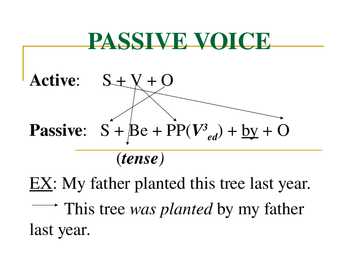
written 10 letters to her. By the end of next week, 10 letters will have been written to her. MODAL VERBS (MV) IN PASSIVE VOICE Modal Verbs can be used in either the present or past forms. Active: S + MV (not) + V + O Passive: S + MV (not) + Be + PP + by + O EX: We can't solve this problem. This problem can't be solved. PASSIVE VOICE WITH CAUSATIVE FORM Active: S + Has/Have + O1 + V (BI)+ O2 S + Get + O1 + V (toinfinitive) + O2 Passive: S + Has/Have/Get + O2 + PP EX: My father had Tom wash his car. My father had his car washed by Tom OTHER INFINITIVE COMBINATIONS IN PASSIVE VOICE Verbs of liking/loving/wanting/wishing + Object + infinitive form their passive with the passive infinitive. Active: S + V + O1 + toinfinitive + O2 Passive: S + V + O + To Be + PP EX: He wants someone to take photographs. He wants photographs to be taken.
She passed her exam, which surprised everybody. (NOT She passed her exam, what surprised everybody.) My father has just climbed Mont Blanc, which is pretty good for a man of 75. (NOT ... what is pretty good for a man of 75.) 92. Don't use the with society when it has a general meaning. We all have to live in society. (NOT We all have to live in the society.) Rousseau said that society makes people evil. (NOT Rousseau said that the society makes people evil.) 93. Use a toinfinitive after want. I want to go home. (NOT I want go home.) The children want to stay up late. (NOT The children want stay up late.) 94. Use make, not do, with mistake. I have made a mistake. (NOT I have done a mistake.) You can't speak a language without making mistakes. (NOT ... without doing mistakes.) 95. Don't repeat a relative pronoun with another pronoun. There's the man that I work for. (NOT There's the man that I work for him.) She saw a doctor who sent her to hospital
 annaabi.ee