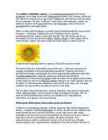
Sunflower
turned towards the east. Over the course(kurss, suund, kulg, kursus, käik, väljak,
müürilade) of the day, they move to track(jälitama) the sun from east to west, while at
night they return to an eastward(ida suunaline, ida poole) orientation. This
motion(liikumine, esildis) is performed by motor cells in the pulvinus, a flexible
segment(segment, lõik ; segmenteerima, tükeldama) of the stem just below the bud. As
�the bud stage ends, the stem(tüvi) stiffens(kangestuma, jäigastuma) and the blooming
stage is reached.
Sunflowers in the blooming stage are not heliotropic anymore. The stem has frozen,
typically in an eastward orientation. The stem and leaves lose their green color.
The wild sunflower typically does not turn toward the sun; its flowering heads may face
many directions when mature. However, the leaves typically exhibit some heliotropism.
Cultivation and uses
A sunflower farm near Mysore, India.

 annaabi.ee