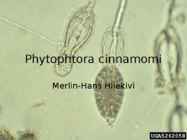
· Sobivate tingimuste juures klamüdospoorid idanevad, tootes mütseele ja sporangiat. · Sporangiad valmivad ja levitavad zoospoore, mis nakatavad taimejuuri, sisenedes juurde juuretipu tagant. · Zoospores peavad ujuma läbi pinnasevee, seega on nakatamine tõenäolisem niiskemates muldades. · Mycelia kasvab läbi juure omastades karbohüdraate ja toitaineid, hävitades juurekudede struktuuri, ,,mädandades" juure, ja takistades taime vett ja toitaineid omastamast. · Sporangia ja klamüdopoorid tekitavad nakatunud juurel mütseeli ja haigus levib järgmisele taimele. Sümptomid · Sümptomid on erinevad: tekitab juuremädanikku, haavandeid ja nekrootilisilaike tüvel, millega kaasneb sageli tume eritis koorel. · Haigustunnuste tagajärjel ei suuda taim omastada enam eluks vajalike toitaineid ning hukkub 3-5 aasta jooksul. · Lisaks suudab P. cinnamomi üle elada kuivad perioodid niiskemas kasvukeskkonnas nagu taimekoed
such as yeasts and molds (British English: moulds), as well as the more familiar mushrooms. Actinomycetes - any member of a heterogeneous group of gram-positive, generally anaerobic bacteria noted for a filamentous and branching growth pattern that results, in most forms, in an extensive colony, or mycelium. The mycelium in some species may break apart to form rod- or coccoid-shaped forms. Many genera also form spores; the sporangia, or spore cases, may be found on aerial hyphae, on the colony surface, or free within the environment. Motility, when present, is conferred by flagella. Many species of actinomycetes occur in soil and are harmless to animals and higher plants, while some are important pathogens, and many others are beneficial sources of antibiotics. Stretomyces - Over 500 species of Streptomyces bacteria have been described. As with the
 annaabi.ee