The Second War 13321357 Between the Kingdom of Scotland and the Kingdom of England Great national crisis Independent nation Union with England 18th century Political union between Scotland and England Treaty of Union It replaced the Scottish systems of currency First World War In 19141918 Provided manpower, ships, machinery, food etc Scotland sent 690,000 men to the war The Battle of Loos They made up 15 per cent of the national armed forces Second World War In 19391945 Shipyards and heavy engineering factories Winston Churchill Industry developed Scottish monarchs The head of state First King of Scots was Kenneth MacAlpin Founded the state The Coronation Oath Elizabeth II Flag of Scotland Saint Andrew's Cross Adopted in 16th century Earliest use as a national symbol One part of the English flag References http://en.wikipedia.org/wiki/Scotland http://en.wikipedia.org/wiki/History_of_Scotland http://en.wikipedia.org/wiki/Wars_of_Scottish_Independence
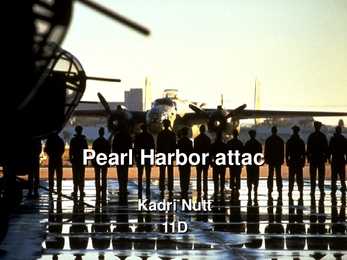
Pearl Harbor attac Kadri Nutt 11D Facts · was a preemptive military strike on the was United States Pacific Fleet base at Pearl Harbor, Hawaii · by the Empire of Japan's Imperial Japanese Navy, on the morning of Sunday, 7 December 1941. · Two attack waves · destroyed two U.S. Navy battleships, one minelayer, two destroyers and 188 aircraft. · Personnel losses were 2,333 killed and 1,139 wounded · Very important fuel storage, shipyards, and submarine facilities were not hit · Japanese losses were minimal at 29 aircraft and five midget submarines, with 65 Japanese servicemen killed or wounded. Reasons · intent was to protect Imperial Japan's advance into Malaya and the Dutch East Indies -- for their natural resources such as oil and rubber -- by neutralizing the U.S. Pacific Fleet. · Both the US and Japan had longstanding contingency plans for war in the Pacific
The toompea Palace was built as the seat of the local government. Today there is the residence of the Parliamnet of Estonia. The main tower is tall Herman with our national flag flying at the top . Toompea is especially rich in historical monuments. The oldest street is Pikk Jalg. Modern industrial development which began in the second half of the 19th century was oriented toward the Russian market. Large textile mills were set up in Narva and electric motor productions, plants and shipyards in Tallinn. Today Narva provides the most Estonian's electricity. Estonian porst, ice-free most of the winter, have always handled much of Russia's trade with western Europe. Deep sea fihing fleets operate from Tallinn and Pärnu. Estonian agriculture mus also find its place in the European aconomy. Agricultural researchers have also detarnimated the best breeds of pigs, sheep and horses suited to Estonian conditions. Pre-War was known in Europe as a potato exporting country. At the
· With a number of New York Times bestsellers and the Guinness Book of World Records Title for most published author, he is one of the most prolific writers of his time. HMS Belfast · Permanently moored near Tower Bridge, this ship was a World War II cruiser in the Royal Navy. · Armed with six torpedoes, and six inch guns with a range of over fourteen miles, the Belfast spent over two years of the war in the Royal Navy shipyards. · Decommissioned after the Korean War, it is now an outpost of the Imperial War Museum. You can see it for yourself what it was like working in the airlocked BoilerRoom or scrambling up and down various ladders. Eltham Palace · Eltham Palace is the only English Art Deco house open to the public. · Initially a moated manor house bought by Edward II in 1305, additions such as the
A Russian general described the time after the war as follows: "Between Narva and Riga one can hear neither a dog barking nor a rooster crowing" Estonia remained under Russian rule and the Baltic- German nobility vowed allegiance to the Tsar., the barons were restored their former privileges. Life changed for the better thanks to the opening of a railway line from St. Petersburg to Tallinn in 1870. Tallinn grew into a major port and an industrial centre, with huge shipyards employing a large workforce. Interest in culture grew and Estonians became conscious of their national identity; dreams of independence gained ground. Tartu was the centre of the movement of national awakening. On 24 February 1918, Estonia was proclaimed an independent democratic republic. Tallinn developed into a modern European capital. A period of prosperity followed, but independence only lasted for 20 years. 1
Unfortunately, prosperity did not last long due to the weakening of the Hanseatic League, epidemics, hunger and wars. Sweden finally managed to take control of the whole of Estonia in 1629. Their rule ended after the Northern War in 1710 when Estonia was joined to the Russian Empire. Life changed for the better thanks to the opening of a railway line from St. Petersburg to Tallinn in 1870. Tallinn grew into a major port and an industrial centre, with huge shipyards. Interest in culture grew and Estonians became conscious of their national identity, dreams of independence gained ground. On 24 February 1918 Estonia was declared an independent country and Tallinn became the capital of the Republic of Estonia. During World War II Estonia was occupied by both German and Russian invaders and Tallinn suffered heavily. The bombing of the city by the Soviet air force on 9 March 1944 left over 20,000 people homeless. During the Russian occupation which followed
Altogether 40% of university-educated Estonians worked in Russia, they made excellent careers as becoming university professors, generals and estate Stewarts. From the point of view of the defence of Petrograd, the Baltic countries had especially important place in Russian military planning. Before the First World War, numerous military installations were erected in Estonia: the Russian Baltic navy port and the shipyards in Tallinn; the grand fortified naval base on the Northern coast bearing the name of Peter I. When the war broke out, the Estonian economy was totally subjected to the needs of the Russian war machine. About 100 000 men were forced into the Russian army; 10 000 of them were killed. In the Russian-German conflict the Estonian politicians supported the Russian side, because unification with Germany meant in their opinion the disappearance of the nation through Germanisation
 annaabi.ee