Character sketch Melanie Oranges are Not the Only Fruit Jeanette Winterson In Oranges are Not the Only Fruit Melanie was the first lover of the main character Jeanette. They were both religious and wanted to be missionaries. Jeanette described Melanie with words like sweet, lovely, beautiful, good and serene. Melanie had lovely grey eyes. Jeanette met Melanie at a fish stand. At first Melanie was reluctant to start a conversation with Jeanette, but eventually she caved in. Week after week Melanie worked at a fish stand boning kippers on a big marble slab and Jeanette went to watch her. Then, one week Jeanette didn't find her because Melanie had got a job in the library. She had to work there every Saturday morning. Melanie lived with her mother who often wasn't home. She had no father
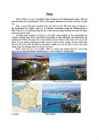
Nice, France. It is a walkway along the sea, where you can enjoy amazing view and see many luxurious private ships. Another place worthy of visiting is the small street parallel to the promenade des Anglais; leading from Nice's downtown, beginning at Place Massena, and shadowing the promenade towards the airport for a short distance about 4 blocks. This area of the city is off limits to cars, and by eliminating traffic creates a more serene setting. On this small strip tourists can find a fine selection of restaurants, where you can try local cuisine, cafes and small shops for clothing, shoes as well as souvenirs. Don't miss out on a visit to Nice. With its´ sandy and unspoilt beaches, interesting places to visit and picturesque natural beauty, it will certainly be unforgettable. Promenade des Anglais View of the port of Nice Location Ville de Nice
Alguses olid teravad rütmid, meloodia oli laia ulatusega ja hüplev, harmoonia oli aktiivne. Kohati oli selline muusika, et lausa hirmuvärinad tulid peale. Peale väikest pausi lülitati makk sisse ning kostis konnade krooksumine, kurehääl ja algaski lindude laul. See oli kohati kurb, siis jälle lõbus. Üldiselt see lugu meeldis mulle kõige rohkem, sest ta oli omapärasem, erinevam teistest ja seda oli huvitav ja põnev kuulata. Siis oli Ton Bruynel`i (1934-1998) muusikapala ,,Serene" (,,Sireen") (1978) ja George Enescu (1881-1955) ,,Cantabile et Presto" (1904). Seitsmendaks looks oli Juozas Pakalnis`e (1913-1948) ,,Svajone" ehk ,,Unistus". See algas rahulikult, kuid molnud minoorne. Kllalt tasane algus, polnud teravaid rtme. Siis muutus tugevamaks, kordustega ning prast seda oli ta jlle rahulik. Lugu oli kllalt lhike, kuid iseloomult oli rahulik ning see vikene lugu suutis edastada oma tunded ja pala lpuks jid ainult head mtted alles.
his name to Frederick Dent). In 1854 the mechanism was ready to be installed in the tower but this was not possible as the tower was incomplete. Denison was therefore able to spend a number of years testing out different types of escapement on the mechanism as it operated in Dent's workshop. It was during this period that he invented the double three-legged gravity escapement, which enables the clock to keep such accurate time. The next 114 years of the clock's history were relatively serene and Big Ben soon developed a reputation for great accuracy. In 1906, the gas lighting of the dials was replaced by electric lighting. Electric winding of the clock was introduced in 1912. The mechanism was overhauled in 1934 and 1956. St. Stephen's hall is the central meeting place where constituents can meet or "lobby" their Members of Parliament. It is from here that you will be shown your direction either to the House of Lords or Commons.
other ships, so he could use his own ship to blunder villages and towns. He removes a warning bell that warns sailors about a secret underwater rock. By doing this, he signs his own death sentence. At a dark night, he crashes his ship to the Rock, because there was no bell to warn him. In the first stanza of the poem Southey describes the surroundings. The tone of the poem is set, at the begging it is very serene and relaxed. The weather and sea are calm, the ship stands, undisturbed, in the water. The reader is supposed to feel joy and relax when this description is given, it brings to mind a sunny and warm summer-day, when everything is just perfect. The point on the first stanza is only to set the tone, it has no real artistic value. The second stanza states that there was no sign of the Inchcape Rock, which lay below the water surface
The Radio Symphony Orchestra was conducted by Arvo Volmer (1962-). The work was broadcast that November. may rely only upon some motifs not bringing essential changes to the general picture. As an arc to this introspection a miniature recapitulation is given The second movement (Adagio) reflects loneliness and distress: Example 65. Without any warning this “vicious circle” of thought is cut off by a serene passage, first by horns(pp) and then the same phrase by woodwind and strings. Contentment and bliss is finally achieved, so long searched and waited for. The third movement (Allegro giocoso), is Scherzo-like, a theme for violins consisting of 15 bars. As a fugato theme it seems somewhat stretched out. The fourth and fifth intervals become essential in the further melodic and harmonic texture. A section from the beginning: Example 66.
subject that was deeply important to me. When he finished, I stood and applauded, catching both him and myself by surprise. But others quickly joined me in the standing ovation and I heard the buzz of conversations around me, the quietly voiced compliments that were well deserved. "You're a fortunate young lady." I turned to look at the woman who spoke, a lovely redhead who appeared to be in her early forties. "We're just...friends." Her serene smile somehow managed to argue with me. People began stepping away from their tables. I was about to grab my clutch so I could leave for home when a young man came up to me. His wayward auburn hair inspired instant envy and his eyes of grayish-green were soft and friendly. Handsome and sporting a boyish grin, he lured the first genuine smile out of me since the ride over in the limousine. "Hello there," he said.
webbed branches. And then I could hear a car passing on the street, and I was free, Charlie's lawn stretched out in front of me, the house beckoning me, promising warmth and dry socks. It was just noon when I got back inside. I went upstairs and got dressed for the day, jeans and a t- shirt, since I was staying indoors. It didn't take too much effort to concentrate on my task for the day, a paper on Macbeth that was due Wednesday. I settled into outlining a rough draft contentedly, more serene than I'd felt since... well, since Thursday afternoon, if I was being honest. That had always been my way, though. Making decisions was the painful part for me, the part I agonized over. But once the decision was made, I simply followed through -- usually with relief that the choice was made. Sometimes the relief was tainted by despair, like my decision to come to Forks. But it was still better than wrestling with the alternatives. This decision was ridiculously easy to live with
delivery. In Tokyo, Togo had been received by the Emperor. He read the text of Roosevelt's message, then a draft of the imperial reply that he and Tojo had prepared. It stated that the 14-part note was to be considered as Japan's response. Hirohito assented, and at 3:15 a.m. Togo withdrew from the Divine Presence. Deeply moved, he recalled, "I passed solemnly, guided by a Court official, down several hundred yards of corridors, stretching serene and tranquil. Emerging at the carriage entrance of the Sakashita Gate, I gazed up at the brightly shining stars, and felt bathed in a sacred spirit. Through the Palace plaza in utter silence, hearing no sound of the sleeping capital but only the crunching of the gravel beneath the wheels of my car, I pondered that in a few short hours would dawn one of the eventful days of the history of the world." Even as he pondered, Japanese planes were circling over Pearl Harbor.
 annaabi.ee