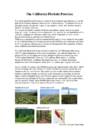
73.451 square kilometers.There are 2.124 endemic plant species, 4 endemic threatened bird kinds, 5 endemic threatened mammals, 8 endemic threatened amphibians and 2 extinct species.There lives 121 persons per 1 square kilometers. As one of only five areas with a Mediterranean type climate in the world, all of which are on the hotspot list, the California Floristic Province is characterized by hot, dry summers and cool, wet winters. The region contains a wide variety of ecosystems, including sagebrush steppe, coastal sage scrub, chaparral, juniper-pine woodland, upper montane-subalpine forest, alpine forest, riparian forest, cypress forests, mixed evergreen forests, Douglas fir forests, sequoia forests, redwood forests, coastal dunes, and salt marshes. Today, about 80,000 square kilometers or 24.7 percent of the original vegetation, remains in more or less pristine condition. Sagebrush steppe coastal sage scrub chaparral
characteristics. There are four major types of deserts: · Hot and dry · Semiarid · Coastal · Cold Location The four major North American deserts of hot and dry deserts are the Chihuahuan, Sonoran, Mojave and Great Basin. Others outside the U.S. include the Southern Asian realm, Neotropical (South and Central America), Ethiopian (Africa) and Australian. The major deserts of semiarid deserts include the sagebrush of Utah, Montana and Great Basin. They also include the Nearctic realm (North America, Newfoundland, Greenland, Russia, Europe and northern Asia). Coastal deserts occur in moderately cool to warm areas such as the Nearctic and Neotropical realm. A good example is the Atacama of Chile. Cold deserts occur in the Antarctic, Greenland and the Nearctic realm. Climate In hot and dry deserts temperatures exhibit daily extremes because the atmosphere
 annaabi.ee