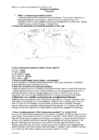
chernozems. 11. How are animals adapted to life in temperate grassland? The animals that live in grasslands have adapted to dry, windy conditions. There are grazing animals (that eat the grass), burrowing animals, and their predators; insects are abundant. A moderate of level species diversity exists on a grassland. 12. Name some temperate grassland animals. Rhea, saiga, Mongolian gerbil, Prairie dog, bison, coyote, 13. What cultivated plants are grown in temperate grassland? Perennial ryegrass and White Clover 14. How are gullies (gully – uhtorg) formed and how do they restrict human activity? (vt. õpik lk 62) A gully is a landform created by running water, eroding sharply into soil, typically on a hillside. Gullies resemble large ditches or small valleys, but are metres to tens of metres in depth and width. When the gully formation is in process, the water flow rate can be substantial, which causes the significant deep cutting action into soil. 15
The effect of botanical composition of lucerne- grass mixture on nutritive value of forage. Agronomy 2010/2011, 133138. Complementary species are used in legume-grass mixtures in order to use environmental resources efficiently and reduce N emission. The aim of this investigation was to study the common lucerne (Medicago sativa, L) ´FSG 408 DP´ and hybrid lucerne (Medicago varia, HL) ´Karlu´-grass mixtures during the years 2007-09. The grasses used in the mixture were hybrid- ryegrass ´Molisto´, tall fescue ´Seine´, meadow fescue ´Darimo´, reed canarygrass ´Palaton´ and smooth bromegrass ´Lincoln´. Maturity stages were accompanied by significant changes in nutritive value: increased NDF, decreased CP, DDM, ME. Especially in the first cut the quality declines rapidly when the forage biomass increases. Dynamics of quality changes depended on the speed of species' seasonal development. Botanical composition of lucerne-grass mixtures showed positive
 annaabi.ee