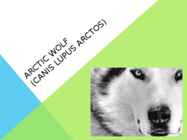
HABITAT AND DISTRIBUTION • They have lived in North America for more than two million years. • The arctic wolf inhabits the Canadian Arctic and the islands, parts of Alaska and northern parts of Greenland. • In their natural habitat, they rarely encounter humans. MAIN THREATS • The greatest threat to the Arctic wolf is climate change. • Extreme weather variations in recent years have made it difficult for populations of muskox and Arctic hares to find food, and this has caused a decline in numbers. CLIMATE CHANGE THANK YOU FOR LISTENING! REFERENCES • http://en.wikipedia.org/wiki/Arctic_wolf • http://wwf.panda.org/about_our_earth/species/profiles/mammals/arcticwolf/ • Pictures from www.google.com
about 3,353 metres (11,000 feet). Underneath the ice cover are the ancient rocks of the Greenland Shield, which is geologically related to the Canadian Shield. Drainage is afforded mainly by the so called ice fjords, in which glaciers from the ice caps pass through valleys to the sea, where they form thousands of icebergs each year. The climate is extremely cold, although the south experiences a short summer. The mammals of Greenland are more American than European and include muskox, wolves, lemmings, and reindeer. The varieties of seal and whale, and most of the species of fish and seabird, are also American rather than European. Circumpolar animals, such as polar bears, arctic foxes, polar hares, and stoats, are also found. Greenlanders are a people of mixed ancestry, primarily Inuit and European, especially Danish Norwegian. Nearly all live on the narrow southwest coastal fringe. Fishing, sealing, and
 annaabi.ee