conditions, although full sun is tolerated if there is sufficient moisture. The soil should be a rich silty loam or clay loam with above average amounts of organic matter. The leaves have a tendency to turn yellowish green when exposed to full sun under dry conditions – this reaction is normal, and is not necessarily a sign of poor health. This plant is very easy to grow, and it will spread under favorable conditions. This wildflower will adapt to lawns, especially if they are not mowed too often during the spring or cut too low. HABITAT & RANGE The native Common Blue Violet occurs in every county in Illinois and it is very common (see Distribution Map). Natural habitats include moist to mesic black soil prairies, open woodlands, woodland edges, savannas, and wooded slopes along rivers or lakes. Indeveloped areas, it can be found in lawns, city parks, moist waste areas, and along hedges or buildings.
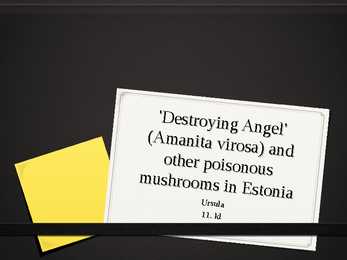
'Destroying A ngel' (Amanita vir osa) and other poison ous mushrooms in Estonia Ursula 11. kl Destroying Angel 0 Commonly referred to as the Destroying Angel, Amanita virosa is a deadly poisonous fungus. The Destroying Angel is more plentiful in mountainous areas and grow in or near the edges of woodlands. They can also be found on lawns or grassy meadows near trees or shrubs. 0 Destroying Angels usually appear in July, August and September. Immature specimens of A. virosa resemble several edible species commonly consumed by humans, increasing the risk of accidental poisoning. Description of Destroying Angel 0 Caps of the Destroying Angel are 5 to 10cm in diameter, pure white, and without any marginal striations. The cap is initially egg- shaped or occasionally almost flat. Amanita
.............................. times this summer, and the grass is turning brown and dying. e. ............................................... experts say you should fertilize your lawn in the fall. f. It didn't seem to do my lawn ......................................... good. g. .................................................... advice you get from experts doesn't seem to help. h. ..................................... of my neighbors ignore their grass, and they have better lawns this year. 3.Fill in the gaps with one of the following quantifiers: a little, little, a few, few. a. They say ............................................................... knowledge is a bad thing. b. I know ..................................................... instances where that proves true. c. ............................................ people know as much about computers as Tomas does. d.But it does him .......................................... good when the whole system goes down.
After a shaky start, the Royal Family has become increasingly enthusiastic about the Show. Initially there was no set pattern as to which day or days they attended, but in 1920 the Royal Visits moved from public-access days to Press Day, on the Monday, to avoid the crowds. Gradually their visit a major highlight for many exhibitors has become bound up with the Chelsea tradition. The nurserymen and the gardeners pick tiny specks from their lawns, vacuum their sheets of water and change from muddy dungarees to smart clothes in preparation for the reigning monarch's visit during the Monday afternoon ( and, almost as important, the dark-suited judges, who are also assessing that day) King George's popular son Edward VIII both enjoyed and understood gardening. As Prince of Wales not only did he visits with the official Royal Party but would also return for a second look. In 1934 he purchased an entire rock garden from the Show to
Social sci- entists first became aware of its effectiveness in 1966 when psychologists Jonathan Freedman and Scott Fraser published an astonishing set of data. They reported the results of an experiment in which a researcher, posing as a volunteer worker, had gone door to door in a residential California neighborhood making a preposterous request of homeowners. The homeowners were asked to allow a public-service bill- board to be installed on their front lawns. To get an idea of the way the sign would look, they were shown a photograph depicting an attractive house, the view of which was almost completely obscured by a very large, poorly lettered sign reading DRIVE CAREFULLY. Although the request was normally and understandably re- fused by the great majority of the residents in the area (only 17 percent complied), one particular group of people reacted quite favorably. A full 76 percent of them of-
"Take the one-oh-one north," he ordered. It was surprisingly difficult to concentrate on the road while feeling his gaze on my face. I compensated by driving more carefully than usual through the still-sleeping town. "Were you planning to make it out of Forks before nightfall?" "This truck is old enough to be your car's grandfather -- have some respect," I retorted. We were soon out of the town limits, despite his negativity. Thick underbrush and green-swathed trunks replaced the lawns and houses. "Turn right on the one-ten," he instructed just as I was about to ask. I obeyed silently. "Now we drive until the pavement ends." I could hear a smile in his voice, but I was too afraid of driving off the road and proving him right to look over and be sure. "And what's there, at the pavement's end?" I wondered. "A trail." "We're hiking?" Thank goodness I'd worn tennis shoes. "Is that a problem?" He sounded as if he'd expected as much. "No." I tried to make the lie sound confident
 annaabi.ee