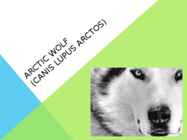
S) T O RC LF A O US W P I C LU C T S R I A AN (C ARCTIC WOLF, POLAR WOLF, WHITE WOLF • Weight: 45-70kg • They are not fast runners. • They hunt in packs. • They prey mainly on caribou and muskoxen, but also arctic hares, seals, ptarmigan, lemmings and smaller animals such as waterfowl. ARCTIC WOLVES ARE SMALLER THAN GREY WOLVES, THEY ALSO HAVE SMALLER EARS AND SHORTER MUZZLES TO RETAIN BODY HEAT. GREY WOLF ARCTIC WOLF HABITAT AND DISTRIBUTION • They have lived in North America for more than two million years. • The arctic wolf inhabits the Canadian Arctic and the islands, parts of Alaska and northern parts of Greenland.
thousands of icebergs each year. The climate is extremely cold, although the south experiences a short summer. The mammals of Greenland are more American than European and include muskox, wolves, lemmings, and reindeer. The varieties of seal and whale, and most of the species of fish and seabird, are also American rather than European. Circumpolar animals, such as polar bears, arctic foxes, polar hares, and stoats, are also found. Greenlanders are a people of mixed ancestry, primarily Inuit and European, especially Danish Norwegian. Nearly all live on the narrow southwest coastal fringe. Fishing, sealing, and
Kolmas tase Neljas tase Viies tase Information Muutke teksti laade Length: body 100 cm- 160 cm. Tail35 Teine tase Kolmas tase cm- 50 cm. Neljas tase Weigth: 30 kg- 50 kg Viies tase Adobe: underwoods, cultural Landscapes, Food: hares, smaller predators, rodents, Puppies: 3-7. Life: 5-10 years. Red Deer Muutke teksti laade Teine tase Kolmas tase Neljas tase Viies tase Information Muutke teksti laade Length: Teine tase Kolmas tase Neljas tase Viies tase used materials Game cards. http://en.wikipedia.org/wiki/Main_Page
seega täitis koloss ka majaka funktsioone. Valgusega ei ole kolossi ehitamisel mängitud. Rhodose välispind on pronksist. Järelikult see on metallist ja suure läikimisega. Suur läikivus näitab, kui suursugune, võimas ning hiiglaslik on koloss. See oli silmipimestav pronkskuju. Mõnedel andmetel olevat kuju ehitatud aastatel 292 eKr280 eKr ja ehitus olevat kestnud 12 aastat. Teiste arvates alustanud aga Kreeka kuulsa kujuri Lysippose õpilane skulptor Chares (Hares) ehitamist 303. a eKr ja lõpetanud 291. a eKr. Kuju ehitati hellenistliku kunsti ajal, mil ideaali kujutamine asendus realismiga. Hellenistlikud teosed erinevad klassikalistest tihti oma mõõtude poolest. Hellenismi ajal eelistati kas hiiglaslikke või siis hoopis väikesi kujutisi. Rhodose koloss oli hiiglaslik kujutis. Minu arvates on Rhodose koloss väga võimas kuju. Mulle meeldib tema omapärasus, hiiglaslik suurus ja asend. Pronkskujul on mitmekülgne legend, mis
This allows the claws to always be exposed, acting like cleats when the cheetah is running. The tail is also designed to help maintain balance at high speeds and during quick turns. Other features of the cheetah include its tan coat with many small, round black spots and black tear- shaped marks around the eyes. In fact, the name "cheetah" has its origins in the Hindu word "chita", meaning "the spotted one." The cheetah eats gazelles, young antelope, young calves, warthogs, hares, and game birds. They typically stalk their prey until they are only 30 to 90 feet away. They then burst into a chase that lasts about 20 seconds. The cheetah successfully catches its prey in about half of the chases. Cheetahs prefer grasslands where they have plenty of room to chase and capture their prey. They once roamed in most of the open area of Africa, in the grasslands of India, southern Russia, Iran, and Pakistan. Today, however, most cheetahs are found
some birches in the lower latitudes. Willows do grow on some parts of the tundra but only as low carpets about 8 cm high. Most plants grow in a dense mat of roots that has developed over thousands of years. The soil is very low in nutrients and minerals, except where animal droppings fertilize the soil. Although there isn't a lot of biodiversity, only 48 species of land mammals are found on the tundra, there are a lot of each species. These consist of slightly modified shrews, hares, rodents, wolves, foxes, bears and deer. There are huge herds of reindeer in North America that feed on lichens and plants. There are also smaller herds of musk oxen. Wolves, wolverines, arctic foxes, and polar bears are the predators of the tundra. Smaller mammals are snowshoe rabbits and lemmings. There aren't many different species of insects in the tundra, but black flies, deer flies, mosquitoes and "no-see-ums" (tiny biting midges) can make the tundra a miserable place to be in the summer
mammals, make underground burrows and hibernate until the spring or warmer weather arrives. When these animals hibernate their body temperatures can drop near freezing. Their hearts also slow so much that they are barely alive. Black bears also avoid the winter by sleeping in their dens. They go into a deep sleep and only wake up several times during the winter to leave their dens. Temperate grassland- Plants are also food for animals. Most temperate grasslands are inhabited by hares, mice, and other small rodents. These animals have sharp teeth that are able to easily gnaw through grass. Some of the familiar rodents found in the North American grasslands are prairie dogs, mice, rats, and ground squirrels. Prairie dogs are cute, burrowing rodents that live in underground communities. A dominant male heads a prairie dog family. They make their home in underground burrows that consist of several chambers and entrances
 annaabi.ee