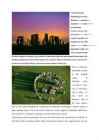
Mike Parker Pearson, head of the Stonehenge Riverside Project, has suggested that Stonehenge was part of a ritual landscape and was joined to Durrington Walls by their corresponding avenues and the River Avon. The area around Durrington Walls henge was a land of the living, whilst Stonehenge was a domain of the dead. A journey along the Avon to reach Stonehenge was part of a ritual passage from life to death, to celebrate past ancestors and the recently deceased. [11] On the other hand, Geoffery Wainwright, president of the Society of Antiquaries of London, and Timothy Darvill have suggested that Stonehenge was a place of healing the primeval equivalent of Lourdes. [12] They argue that this accounts for the high number of burials in the area and for the evidence of trauma deformity in some of the graves. However they do concede that the site was probably multifunctional and used for ancestor worship as well.[13]
methods were used, usually asserting that the stones were impossible to move otherwise. However, conventional techniques using Neolithic technology have been demonstrably effective at moving and placing stones of a similar size. Proposed functions for the site include usage as an astronomical observatory, or as a religious site. More recently two major new theories have been proposed. Professor Geoffery Wainwright OBE, FSA, president of the Society of Antiquaries of London, and Professor Timothy Darvill, OBE of Bournemouth University have suggested that Stonehenge was a place of healing the primeval equivalent of Lourdes. They argue that this accounts for the high number of burials in the area and for the evidence of trauma deformity in some of the graves. However they do concede that the site was probably multifunctional and used for ancestor worship as well.
 annaabi.ee