Nouns are commonly thought of as "naming" words, and specifically as the names of "people, places, or things". Nouns also denote abstract and intangible concepts such as birth, happiness, evolution, technology, management, imagination, revenge, politics, hope, cookery, sport... Determiners are followed by the noun. Determiners are the, a or an. The determiner the is known as the definite article and a is indefinite article. Verbs have traditionally been defined as „action“ words or „doing“ words. Travels, sings, walked, cooked... Adjectives typically describe an attribute of a noun. Cold, large, violent, beautiful... Adverbs are used to modify a verb, and adjective, or another adverb. Slowly, quickly, softly, suddenly, gradually... Prepositions typically come before a noun. Across, after, at, before, by, during, from, into, in... Conjunctions are used to express a connection between words. And, but, or... Formulaic expressions are ...
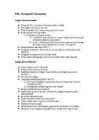
The Germanic Invasions Anglo-Saxon invasion During the 5th c. a number of Germanic tribes invaded The Angles, the Saxons, the Jutes Different peoples, but common language and customs Advance halted by King Arthur Distortions of popular history In folklore, myth (and films) a great English hero, an example of medieval nobility and chivalry In fact a Romanized Celt, lived before medieval times, fought the Anglo-Saxons (people who became "the English") Predominated by the end of the 6th c. Kingdoms established: Wessex, Essex, Sussex, Mercia, Northumbria, East Anglia etc. Kingdoms constantly at war with each other Celtic culture and language survived in Scotland, Wales and Cornwall Anglo-Saxon lifestyle A great impact on the countryside Introduced new farming methods Established numerous villa...
1. Be ready to explain the terms (lecture 1): language, linguistics, synchronic approach to language, diachronic approach to language, linguistic competence, linguistic performance, what is grammar?, prescriptive grammar vs. descriptive grammar; phonology, phonetics, phone, allophone, phoneme; morphology, morphemes (types of morphemes), morphs, allomorphs, types of affixes, derivational affixes, inflectional affixes; open vs closed class words; syntax. Language: a systematic, conventional use of sounds, signs or written symbols in a human society for communication and self-expression. - human language at all levels is rule- or principle-governed. Linguistics: the scientific study of human natural language Synchronic approach to language: Diachronic approach to language: Linguistic competence: Linguistic performance: What is grammar?: "The sounds and sound patterns, the basic units of meaning, such as words, and the rules to combine them...
THE W R I T E R ' S JOURNEY M Y T H I C STRUCTURE FOR W R I T E R S THIRD EDITION CHRISTOPHER VOGLER S C R E E N W R I T I N G / W R I T I N G Christopher Vogler explores the powerful relationship between mythology and storytelling in his clear, concise style that's made i this book required reading for movie executives, screenwriters, playwrights, fiction and non-fiction writers, scholars, and fans of pop culture all over the world. Discover a set of useful myth-inspired storytelling paradigms like "The Hero's Journey," and step-by-step guidelines to plot and • character development. Based on the work of Joseph Campbell, The Writers Jour...
 annaabi.ee